25 ChatGPT Prompt Templates You Can Reuse for Work, Study, and Everyday Life
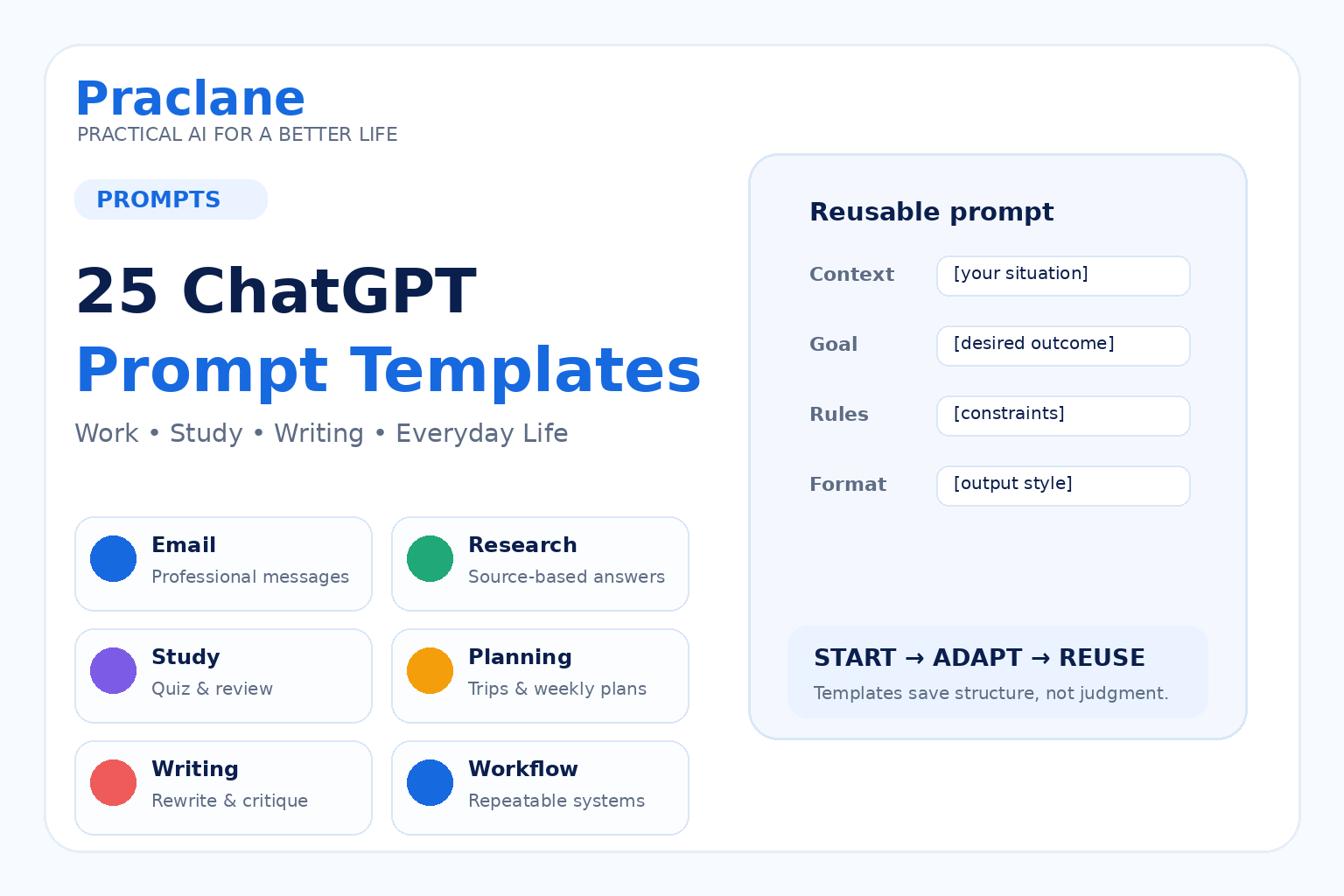
You do not need to invent a new prompt every time you use ChatGPT.
A small library of reusable ChatGPT prompt templates can save time while still giving you enough flexibility to adapt each request to the situation.
This guide gives you 25 practical templates for work, study, writing, research, planning, and everyday life. Replace the text inside brackets with your own details.
If you want to understand why these templates work, see our guide to writing better ChatGPT prompts. If you are completely new to ChatGPT, start with our beginner guide.
How to Use These Templates
Do not copy a template blindly. Replace the placeholders, remove instructions you do not need, and add any facts that would materially change the answer.
A template is a starting structure, not a magic formula.
Work and Productivity Prompts
1. Professional Email
Draft an email to [recipient/role]. Context: [situation]. My goal is [outcome]. Include [key facts]. Tone: [tone]. Keep it under [length]. End with [call to action]. Do not invent facts or commitments.
For more situations, see our dedicated ChatGPT email prompt guide.
2. Meeting Notes to Action Items
Turn these meeting notes into four sections: Decisions, Action Items, Owner, and Deadline. Do not guess missing owners or dates. Mark missing information as Not specified: [notes]
3. Weekly Status Report
Turn these notes into a concise weekly status report with Progress, Risks, Next Steps, and Decisions Needed. Use bullets where helpful. Keep it under [length]: [notes]
4. Prioritize a Task List
Prioritize this task list using urgency, impact, effort, and dependencies. Explain the top five choices briefly and flag anything that cannot be prioritized without more information: [tasks]
5. Turn Rough Notes Into a Document
Turn these rough notes into a [report/proposal/brief]. Audience: [audience]. Goal: [goal]. Use clear headings, remove repetition, preserve uncertain points as questions, and do not add unsupported facts: [notes]
6. Compare Options
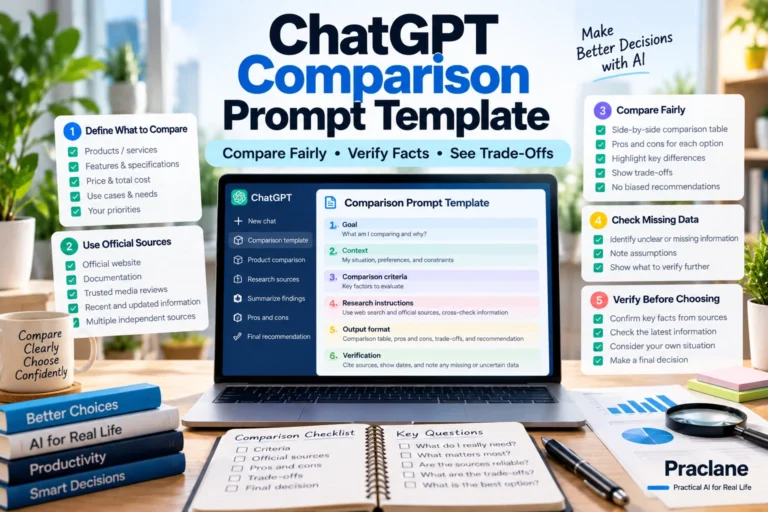
Compare [option A], [option B], and [option C] for [use case]. Use these criteria: [criteria]. Separate factual differences from subjective trade-offs. Tell me what information is still missing before I decide.
Writing and Editing Prompts
7. Rewrite for Clarity
Rewrite this text for clarity. Keep the meaning and factual claims unchanged. Remove repetition, shorten long sentences, and use plain language. Audience: [audience]. Text: [paste text]
8. Change the Tone
Rewrite this message so it sounds [warm/direct/professional/calm]. Keep the request and important details unchanged. Avoid sounding [overly formal/apologetic/aggressive]: [text]
9. Shorten Without Losing the Point
Reduce this text to about [word count] words. Preserve the main conclusion, essential evidence, dates, numbers, and required action. Remove examples and repetition before removing important facts: [text]
10. Critique a Draft
Review this draft without rewriting it yet. Identify the five most important problems with clarity, logic, structure, evidence, or tone. Quote only the short phrase needed to identify each issue, then suggest how to improve it: [draft]
Research and Information Prompts
11. Research With Sources
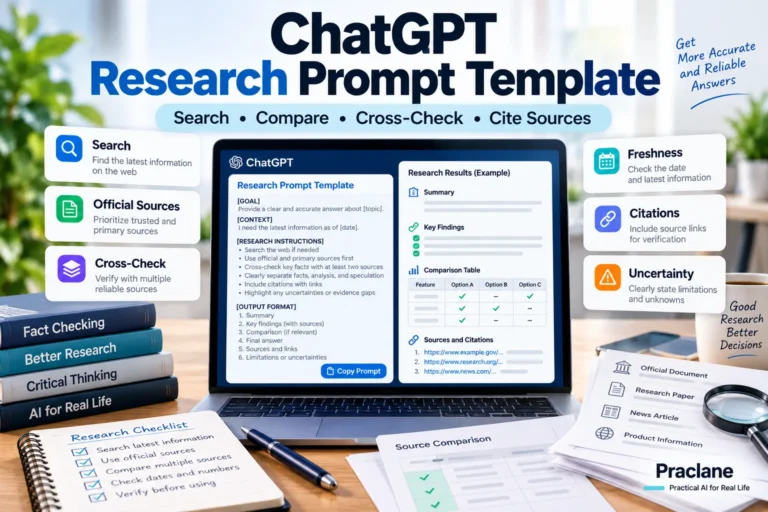
Research [topic] using current web sources. Prefer primary or official sources. Separate established facts from claims or interpretation. Cite the source for each time-sensitive point and list anything that remains uncertain.
For important information, use the checking process in our guide to verifying ChatGPT answers.
12. Summarize a Long Source
Summarize this material for [audience]. Give me: 1) the main idea, 2) five key points, 3) important numbers or dates, 4) unresolved questions, and 5) what I should read in full rather than relying on the summary: [material]
13. Explain a Topic at My Level
Explain [topic] for someone at [level]. Start with a plain-language explanation, then give one concrete example and one analogy. Finish with three questions I should be able to answer if I understood it.
14. Find the Weakness in an Argument
Analyze this argument. Separate the conclusion, supporting evidence, assumptions, and missing evidence. Identify the strongest counterargument and explain what evidence would change the conclusion: [argument]
Study and Learning Prompts
15. Quiz Me One Question at a Time
Quiz me on [topic] at [level]. Ask one question at a time, wait for my answer, then give brief feedback before the next question. Focus more often on areas I get wrong.
16. Build a Study Plan
I have [time] until [exam/deadline] and can study [available time]. Topics: [topics]. Weak areas: [weak areas]. Build a realistic plan with review, practice, and catch-up time. Do not schedule every minute.
17. Correct My Language Practice
Correct this [language] text while keeping my wording whenever possible. Show my original sentence, the corrected version, and a short explanation. Keep corrections appropriate for a [level] learner: [text]
See our language-learning guide for a complete practice routine.
18. Turn Notes Into Flashcards
Turn these notes into [number] flashcards. Put one clear question on the front and a concise answer on the back. Prioritize concepts and relationships over trivia: [notes]
Planning and Everyday-Life Prompts
19. Plan a Trip
Plan a [number]-day trip to [destination] for [travelers]. Budget: [budget]. Interests: [interests]. Pace: [slow/moderate/fast]. Transport: [transport]. Group nearby activities together and clearly mark details that need current web verification.
For a full workflow, see our ChatGPT travel-planning guide.
20. Plan a Week
Help me plan this week. Fixed commitments: [commitments]. Priorities: [priorities]. Available work blocks: [times]. Protect [rest/exercise/family time]. Build a realistic schedule with buffer time and identify what should be postponed.
21. Create a Meal Plan
Create a [number]-day meal plan for [number] people. Budget: [budget]. Foods we like: [foods]. Foods to avoid: [foods]. Cooking time on weekdays: [time]. Reuse ingredients across meals and finish with one organized grocery list.
22. Make a Packing Checklist
Create a packing checklist for [destination] in [month] for [number] days. Activities: [activities]. Luggage limit: [limit]. Separate essentials, clothing, electronics, documents, and optional items.
Decision and Problem-Solving Prompts
23. Break a Problem Into Steps
Help me solve this problem: [problem]. First separate what is known, unknown, and assumed. Then break the problem into the smallest useful steps. Ask me for missing information before making assumptions that could change the answer.
24. Pre-Mortem a Plan
Assume this plan failed six months from now: [plan]. List the most plausible reasons, early warning signs, and one preventive action for each. Focus on realistic operational risks rather than unlikely disasters.
25. Turn a Repeated Task Into a Workflow
I repeat this task regularly: [task]. Help me turn it into a reusable workflow. Define the Trigger, Input, Process, Output, and Review step. Identify which parts can be standardized and which still require human judgment.
For more advanced examples, see our guide to automating repetitive tasks with ChatGPT.
How to Improve Any Template
- Add the audience or person the result is for.
- Add the real constraints: time, budget, length, tools, or rules.
- Give the facts ChatGPT should not guess.
- Specify what a good output should look like.
- Ask it to flag missing information instead of inventing it.
For high-stakes or time-sensitive information, verify the answer rather than relying on a polished response alone.
For a deeper ideation workflow, try our ChatGPT brainstorming prompts, which are designed to move beyond generic idea lists.
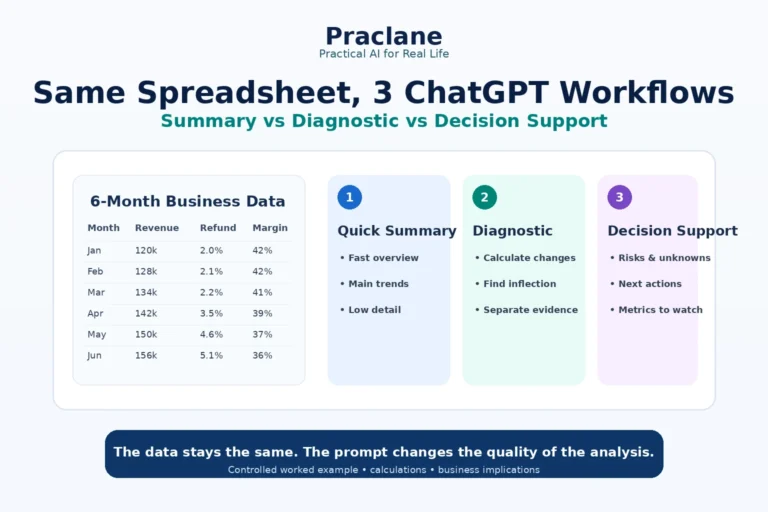
For a controlled example of why prompt structure matters, see our meeting-notes prompt comparison, where the same input is tested with three different prompt styles.
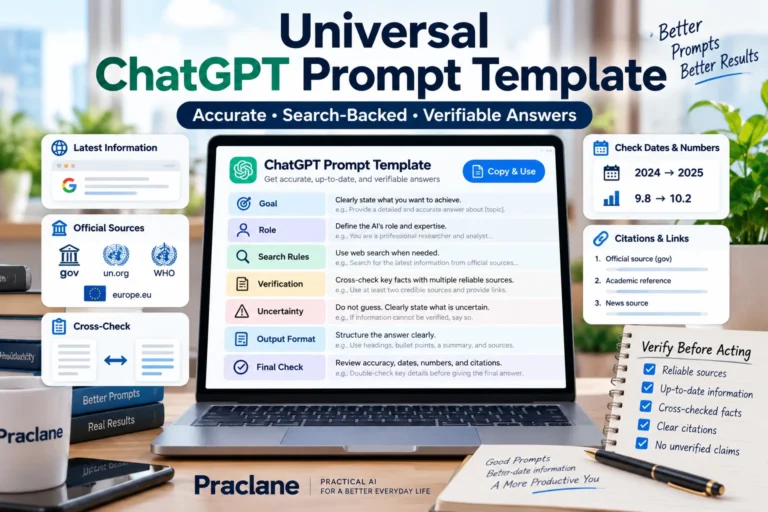
For a reusable foundation focused on search quality, source checks, verification, and uncertainty, start with our Universal ChatGPT Prompt Template.
Final Thoughts
The point of a prompt library is not to collect hundreds of clever phrases. It is to keep a small set of structures that solve problems you actually repeat.
Save the templates you use, delete the ones you do not, and improve them with real context over time.