How to Learn a Language With ChatGPT: 12 Practical Methods That Actually Help
ChatGPT can be useful for language learning because it lets you practice on demand, adjust the difficulty instantly, and get explanations when you do not understand something.
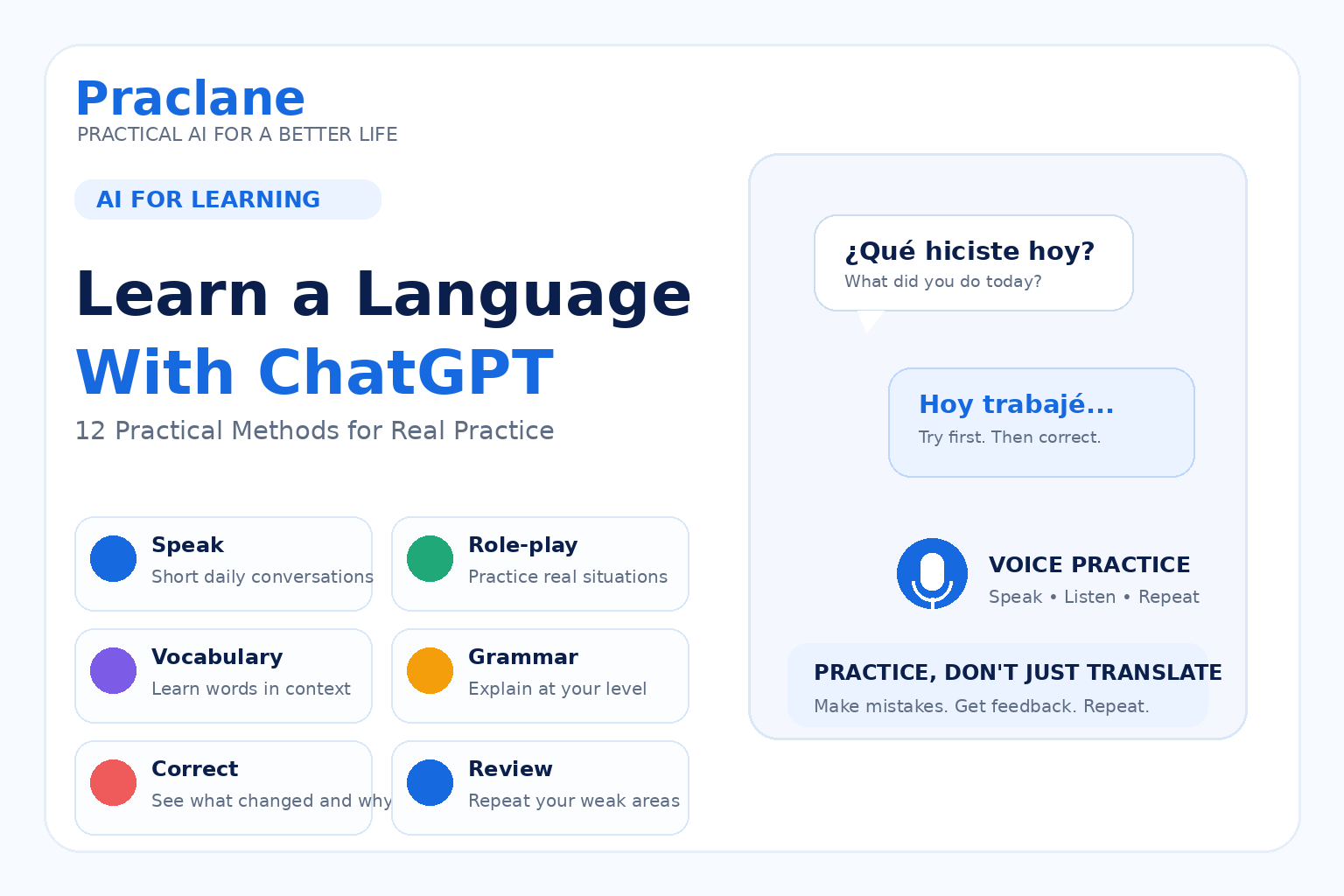
The most effective approach is not to ask ChatGPT to “teach me Spanish” or “teach me English.” It is to use it for specific practice: conversation, vocabulary, corrections, role-play, grammar, review, and speaking.
This guide shows how to learn a language with ChatGPT using 12 practical methods you can repeat every week.
For a broader study workflow, see our guide to studying with ChatGPT. If your prompts are too vague, our prompt guide explains how to add useful context.
What ChatGPT Is Good at for Language Learning
ChatGPT is especially useful for creating unlimited practice, changing the level of explanations, correcting writing, simulating everyday conversations, and helping you review mistakes.
It can also be used for speaking practice through ChatGPT Voice. OpenAI’s current Voice documentation says you can speak with ChatGPT and hear spoken responses, switch languages during a conversation, and ask it to change its pace or response style.
The goal is to produce the language yourself, not just read AI-generated translations.
1. Start With a Simple Level Check
Before building a routine, ask ChatGPT to estimate your current level through a short interaction.
Test my Spanish with 10 short questions. Start easy and gradually increase the difficulty. Ask one question at a time. At the end, estimate my approximate level and list the three skills I should focus on first.
Treat the result as a rough starting point, not an official language certification.
2. Practice Short Daily Conversations
Have a 10-minute conversation with me in Spanish at an A2 level. Use short sentences. Ask one question at a time. Correct only mistakes that affect meaning, and explain the correction briefly in English.
Short, frequent conversations are easier to maintain than occasional long sessions.
3. Use Role-Play for Real Situations
Role-play turns abstract vocabulary into language you may actually need.
Role-play a restaurant conversation in Madrid. You are the server and I am the customer. Keep the language beginner-friendly. Do not translate unless I ask. Correct me after each response.
You can repeat this with hotels, airports, work meetings, doctor visits, shopping, directions, or job interviews.
4. Learn Vocabulary in Context
Memorizing isolated word lists can make recall difficult. Ask for vocabulary tied to a situation.
Teach me 15 Spanish words and phrases for ordering food. For each item, give a simple example sentence. Then quiz me using short situations instead of asking for direct translations.
5. Turn New Words Into Active Recall
These are the 12 words I learned today: [list]. Test me one at a time. Mix recognition, sentence completion, and short translation questions. Repeat the words I miss more often.
This turns ChatGPT into a flexible review partner instead of a static vocabulary list.
6. Get Grammar Explanations at Your Level
Explain the difference between por and para for an A2 Spanish learner. Use plain English, give four short examples, and finish with five practice questions. Do not introduce advanced exceptions yet.
Ask for the smallest explanation you need. Too many rules at once can make a simple point harder to remember.
7. Correct Your Writing Without Rewriting Everything
If ChatGPT rewrites your entire paragraph, you may not notice what you actually did wrong.
Correct this Spanish paragraph. Keep my wording whenever possible. Show: 1) my original sentence, 2) the corrected sentence, and 3) a short explanation of the mistake. Do not make the text more advanced than my current level.
Corrections are most useful when you can see exactly what changed and why.
8. Practice Speaking With Voice
Voice lets you move beyond typing and practice the speed and pressure of a real conversation.
Let’s practice Spanish by voice. Speak slowly at first. Ask me simple questions about my day. If I get stuck, give me one hint instead of immediately switching to English.
You can ask ChatGPT to speak faster or slower and to use a different language during the voice conversation. Availability and limits can vary by plan and app.
9. Practice Listening With Short Dictation Exercises
In Voice, ask ChatGPT to say a short sentence without showing you the translation first. Then repeat or type what you heard.
Give me one short Spanish sentence at a time for listening practice. Use everyday vocabulary. Let me repeat what I heard, then tell me what I missed and say the sentence again slowly.
10. Build a Personal Error Log
Your repeated mistakes are more useful than a generic list of grammar topics.
Based on today’s practice, create an error log with three columns: mistake pattern, corrected example, and what I should practice next. Group repeated mistakes together.
At the start of your next session, review the top two or three patterns instead of restarting from zero.
11. Create a Weekly Study Plan You Can Actually Follow
I can study Spanish for 30 minutes a day, five days a week. My main goal is conversation. Build a weekly plan that includes speaking, vocabulary review, grammar, and one writing task. Keep each session simple enough to complete after work.
A realistic plan is more valuable than an ambitious schedule you abandon after three days.
12. Review Your Progress Every Few Weeks
Review my last three weeks of language practice in this chat. Identify what has improved, what mistakes still repeat, and what I should change for the next two weeks. Give me three measurable goals.
If you keep language practice inside the same Project or organized set of chats, it is easier to preserve context and compare progress over time.
A Simple 30-Minute Language Routine
- 5 minutes: review yesterday’s mistakes.
- 10 minutes: have a short conversation or role-play.
- 10 minutes: practice vocabulary or one grammar point.
- 5 minutes: write a short summary and ask for corrections.
The exact timing is less important than repeating a mix of recall, production, correction, and conversation.
What ChatGPT Should Not Replace
ChatGPT can generate practice and feedback, but it should not replace every source of language input. Real conversations, native audio, books, classes, teachers, and everyday exposure give you accents, cultural context, and communication pressure that an AI practice session cannot fully reproduce.
Also remember that ChatGPT can make mistakes. If a grammar point or translation matters, compare it with trusted learning materials or another reliable source.
For a broader checking process, see our guide to verifying ChatGPT answers.
Common Mistakes When Learning a Language With ChatGPT
- Using translation for every sentence instead of trying first.
- Practicing only reading and never producing the language.
- Asking for corrections that rewrite everything above your level.
- Learning large vocabulary lists without context or review.
- Changing topics constantly instead of revisiting repeated mistakes.
- Trying to study for too long instead of building a repeatable routine.
Frequently Asked Questions
Can ChatGPT help me learn a language from zero?
Yes. It can create beginner explanations, simple dialogues, vocabulary practice, and short exercises. Beginners usually benefit from keeping the language level low and instructions very specific.
Can I practice speaking with ChatGPT?
Yes. ChatGPT Voice supports spoken conversations and can be used for role-play, everyday conversation, and listening practice. Exact voice options and usage limits depend on your account and plan.
Should I use ChatGPT for translation?
Translation is useful when you are stuck, but using it for every sentence can reduce active practice. Try producing the sentence yourself first, then compare and correct it.
For speaking practice and real-time conversation, continue with our ChatGPT Voice in 2026 guide.
Final Thoughts
ChatGPT becomes much more useful for language learning when you stop treating it as a translator and start treating it as a practice partner.
Speak, write, make mistakes, get feedback, and repeat the weak areas. That cycle is more valuable than collecting perfect example sentences you never use.