How to Use ChatGPT for Exam Prep: 10 Practical Study Workflows
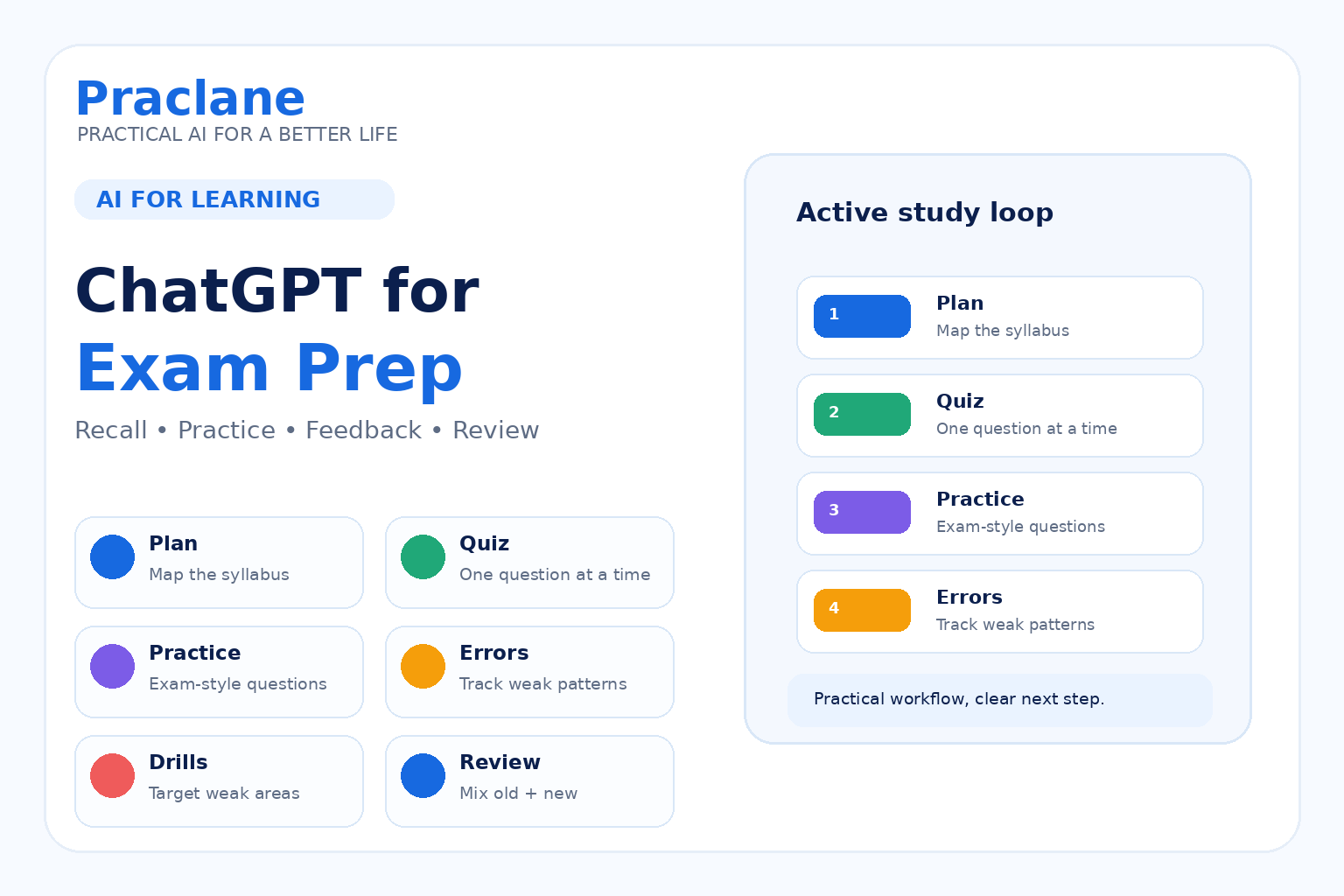
Exam preparation becomes easier when you stop treating studying as one long activity and break it into specific jobs: planning, recall, practice, correction, review, and final revision.
ChatGPT can help with each of those jobs, but the most useful approach is to make it generate practice that forces you to think instead of simply giving you answers.
This guide shows how to use ChatGPT for exam prep with 10 practical study workflows.
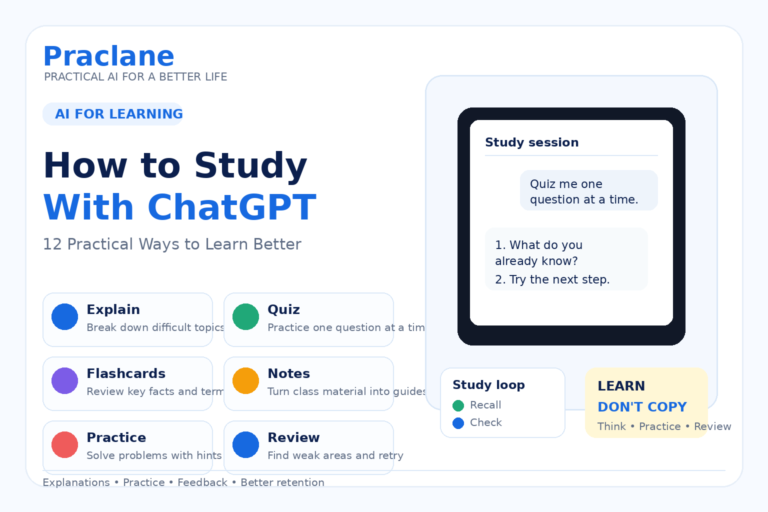
For a broader learning system, see our ChatGPT study guide. For reusable instructions, see our prompt templates.
The Main Rule: Make ChatGPT Test You
Reading explanations can feel productive even when very little is being remembered. Exam prep improves when you repeatedly try to retrieve information, solve problems, explain concepts, and correct mistakes.
Use ChatGPT to create retrieval and practice—not to remove the thinking from the task.
1. Turn the Syllabus Into a Study Map
Turn this syllabus into a study map. Group related topics, identify prerequisites, and mark which topics appear foundational versus detail-heavy. Do not invent exam weighting unless it is stated: [syllabus]
This gives you a structure before you start scheduling individual sessions.
2. Build a Realistic Exam Plan
My exam is in [number] days. I can study [time] on weekdays and [time] on weekends. Topics: [topics]. Weak areas: [weak areas]. Build a realistic plan with learning, active recall, practice questions, cumulative review, and two catch-up blocks. Do not schedule every available minute.
A good plan includes buffer time because real study sessions rarely go exactly as expected.
3. Quiz Yourself One Question at a Time
Quiz me on [topic] at [difficulty]. Ask one question at a time and wait for my answer. After I answer, tell me whether the reasoning is correct, explain the key point briefly, and then continue. Ask more questions on the areas I miss.
One-at-a-time questions reduce the temptation to read the answer before attempting the problem.
4. Generate Practice Questions From Your Notes
Create 15 exam-style questions using only these notes. Mix recall, explanation, application, and comparison questions. Do not show the answers until I ask for them. Flag anything in the notes that is too ambiguous to test reliably: [notes]
If the notes are incomplete or wrong, the generated questions can inherit those problems. Check the source material before relying on the question set.
5. Practice Explaining Concepts From Memory
Ask me to explain [concept] in my own words without notes. After I answer, compare my explanation with the key ideas that should be present. Identify missing ideas, incorrect claims, and unnecessary details. Do not rewrite the answer for me until after the feedback.
Being able to recognize an answer is not the same as being able to produce it.
6. Create an Error Log
Based on the questions I missed today, create an error log with: Topic, My Mistake, Correct Principle, Why I Missed It, and What to Practice Next. Group repeated mistake patterns together.
Your repeated errors usually deserve more attention than topics you already answer correctly.
7. Turn Weak Areas Into Targeted Drills
I keep making these mistakes: [mistakes]. Create a short drill focused only on those patterns. Start with easy examples, then increase the difficulty. Stop after 10 questions and summarize what is still weak.
8. Simulate Exam Conditions
Create a [length]-minute practice exam on [topics] with [number] questions. Match this format: [multiple choice/short answer/problem solving/essay]. Do not give hints or answers during the test. After I finish, grade the responses using this rubric: [rubric if available].
When possible, use the real exam format or a teacher-provided rubric rather than asking ChatGPT to invent one.
9. Review With Spaced Mixed Questions
Create a mixed review from topics I studied this week: [topics]. Include more questions from weak areas but keep some older strong topics in the mix. Ask one question at a time and do not group questions by chapter.
Mixing topics helps you practice choosing the right method instead of simply repeating the method from the previous question.
10. Build a Final 48-Hour Review
I have 48 hours before the exam. Here is what I know well, what I still miss, and the exam format: [details]. Build a final review plan that prioritizes high-value weak areas, short retrieval sessions, practice, sleep, and stopping points. Do not introduce a large amount of completely new material unless it is essential.
A Reusable Exam-Prep Prompt
Help me prepare for [exam]. Date: [date]. Format: [format]. Topics: [topics]. Materials I should use: [materials]. Current weak areas: [weak areas]. Available study time: [time]. Build a plan that emphasizes active recall, practice questions, error review, and cumulative review. Test me before explaining answers whenever possible. Do not invent facts that are not in my materials.
What ChatGPT Should Not Replace
ChatGPT should not replace your official syllabus, assigned textbook, teacher instructions, marking rubric, or authoritative reference material. It can misunderstand a topic or generate a plausible but incorrect answer.
When a fact matters, compare it with the source material. Our AI verification guide explains a broader checking process.
Common Exam-Prep Mistakes
- Reading AI explanations for hours without attempting retrieval.
- Asking for answers before trying the question yourself.
- Generating practice questions from unreliable notes.
- Spending equal time on strong and weak topics.
- Doing only chapter-by-chapter practice and never mixing topics.
- Building a study plan with no buffer or catch-up time.
- Using AI-generated exam formats instead of the real format when official information exists.
Frequently Asked Questions
Can ChatGPT make practice exams?
Yes. Give it the topics, level, question types, and real exam format. The quality improves when the source material and marking criteria are provided instead of being invented.
Can ChatGPT grade my answers?
It can give useful feedback, especially when you provide an official rubric or model answer. Treat the result as practice feedback rather than an authoritative grade unless the grading criteria are clear and verified.
Is it better to study with ChatGPT or flashcards?
They solve different parts of the problem. Flashcards are useful for repeated recall, while ChatGPT can create adaptive questions, explanations, drills, and simulations. They can be combined.
When the challenge is understanding dense source material before testing yourself, see how to use ChatGPT to understand difficult texts.
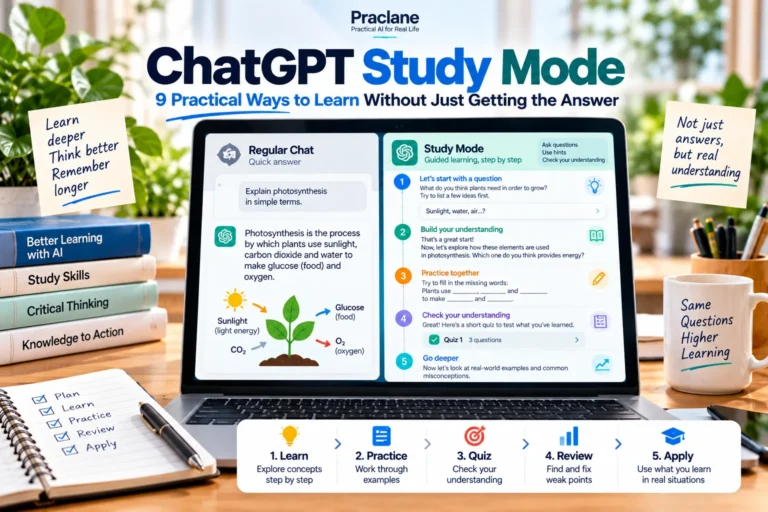
For guided exam practice that emphasizes active recall and step-by-step reasoning, continue with our ChatGPT Study Mode workflows.
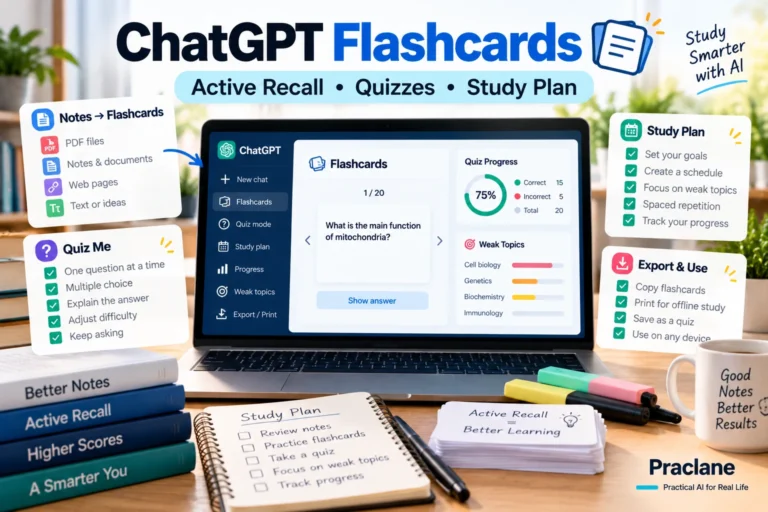
If flashcards are part of your exam prep, use our ChatGPT Flashcards workflow to turn notes into active recall, quizzes, and weak-topic review.
Final Thoughts
ChatGPT is most useful for exams when it makes your study sessions more active.
Try first, retrieve from memory, get feedback, log the mistake, and test the weak area again. That cycle is more valuable than collecting more explanations.