How to Use ChatGPT to Build Better Habits and Daily Routines: 10 Practical Workflows
Building a habit is usually not about knowing what to do. The harder part is making the behavior small enough, clear enough, and realistic enough to repeat when motivation is low.
ChatGPT can help you turn a vague goal into a concrete routine, identify likely obstacles, design fallback versions, and review what is actually working.
This guide shows how to use ChatGPT for habits and daily routines without turning your schedule into an unrealistic productivity plan.
For broader weekly organization, see our weekly planning guide. If you want recurring reminders, see our Scheduled Tasks guide.
The Main Rule: Design for Low-Motivation Days
A routine that only works when you have plenty of time and energy is fragile. A better plan includes a minimum version you can still complete on a difficult day.
The goal is not to create the perfect routine. The goal is to create one you can keep returning to.
1. Turn a Vague Goal Into One Observable Behavior
My goal is [goal]. Help me turn it into one behavior I can clearly observe and complete. Define what counts as done, how often I should do it, and what would make the first version small enough to start.
“Get healthier” is difficult to act on. “Walk for 10 minutes after dinner on four weekdays” is easier to repeat and review.
2. Attach the Habit to an Existing Trigger
Here is the habit I want: [habit]. Here are parts of my day that already happen reliably: [existing routines]. Suggest three realistic trigger points I could attach the habit to. Explain why each trigger might work.
Existing anchors such as waking up, finishing lunch, arriving home, or brushing your teeth can make a new behavior easier to remember.
3. Create a Minimum Version
Create three versions of this habit: Full Version, Normal Version, and Minimum Version. The Minimum Version should take no more than five minutes and still preserve the identity of the habit.
This avoids the all-or-nothing pattern where one busy day turns into abandoning the routine.
4. Identify Friction Before It Happens
Assume I fail to maintain this habit for two weeks. Give me the most likely practical reasons based on my routine: [routine]. Separate time, environment, energy, memory, motivation, and complexity problems. Then suggest one prevention step for each.
A useful plan removes obstacles before relying on willpower.
5. Build an If-Then Recovery Plan
Create if-then recovery rules for this habit. Include what I should do if I miss one day, miss several days, have no time, feel exhausted, travel, or lose access to my normal environment.
Recovery rules matter because habit consistency is rarely perfect.
6. Design a Simple Tracker
Design a simple weekly habit tracker for [habit]. Track only information that could change my decisions. Include completion, difficulty, reason for missing, and one short note. Keep it simple enough to update in under one minute.
Tracking should create information, not become another task that is harder than the habit itself.
7. Review the Pattern Instead of Judging Yourself
Here is my habit log for the week: [log]. Analyze patterns without moral judgment. What conditions made the habit easier? What conditions made it harder? What one change should I test next week?
This turns failure into information about the system rather than a verdict about motivation.
8. Protect the Habit From Schedule Changes
My normal routine changes on [days or situations]. Create a weekday version, weekend version, and disrupted-day version of this habit. Keep the same core behavior while adapting the timing.
Flexible routines are often easier to maintain than routines tied to one exact time.
9. Use Reminders Only Where They Add Value
If forgetting is the real problem, a reminder can help. If the real problem is that the habit is too large, poorly timed, or unpleasant, more notifications usually do not fix it.
I keep missing this habit. Ask me five questions to determine whether the problem is memory, timing, effort, environment, or motivation before suggesting a reminder.
If you decide a recurring reminder is useful, our Scheduled Tasks guide explains how to create and manage one.
10. Run a Weekly Habit Review
Run a weekly review for my habit. Ask: What did I complete? What did I miss? What made completion easier or harder? Is the habit too large? Is the trigger reliable? What one adjustment should I test next week? End with a simple plan for the next seven days.
A weekly review is more useful than constantly redesigning the routine after a single bad day.
A Reusable Habit-Building Prompt
I want to build the habit of [habit]. My current routine is [routine], my main constraint is [constraint], and the reason this matters is [reason]. Help me design one observable behavior, a reliable trigger, a minimum version, likely obstacles, recovery rules, and a one-minute weekly tracking system. Keep the plan realistic rather than ideal.
Common Habit Mistakes
- Starting with too many habits at once.
- Choosing a habit that is too vague to measure.
- Designing only for ideal days.
- Using reminders when the real problem is friction.
- Tracking too much information.
- Changing the routine every time you miss one day.
- Confusing a missed day with a failed habit.
Frequently Asked Questions
Can ChatGPT track my habits automatically?
ChatGPT can help you design a tracker, review logs you provide, and create supported recurring reminders. Whether it can automatically access external tracking data depends on the account, app, connected service, and permissions you use.
How many habits should I work on at once?
There is no universal number. If several new behaviors compete for the same time and attention, starting with fewer usually makes it easier to learn what works.
Should I use daily reminders?
Use reminders when forgetting is the main failure point. If the habit is too difficult, badly timed, or poorly designed, fixing the routine itself is more important.
What should I do after missing several days?
Restart with the minimum version, identify what changed, and adjust the trigger or effort level before trying to return immediately to the full routine.
If meals are one of the routines you want to make easier to repeat, see our guide to using ChatGPT for meal planning.
Final Thoughts
ChatGPT is most useful for habits when it helps you design a system that survives normal life.
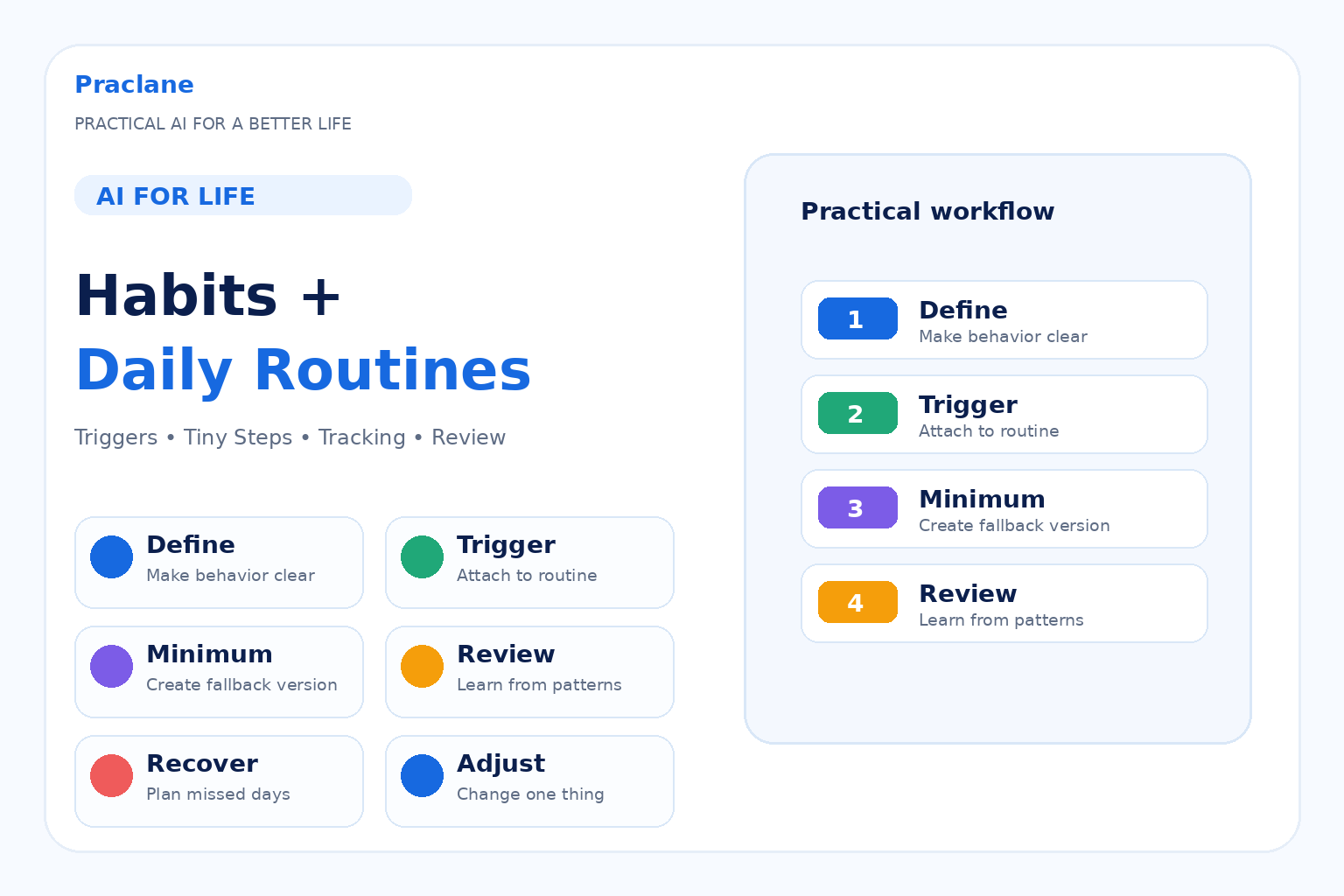
Make the behavior clear, attach it to reality, create a minimum version, review the pattern, and improve the system one change at a time.