20 ChatGPT Prompts for Brainstorming Better Ideas Without Getting Generic Answers
ChatGPT can generate dozens of ideas in seconds. That speed is useful, but the first list is often broad, safe, and predictable.
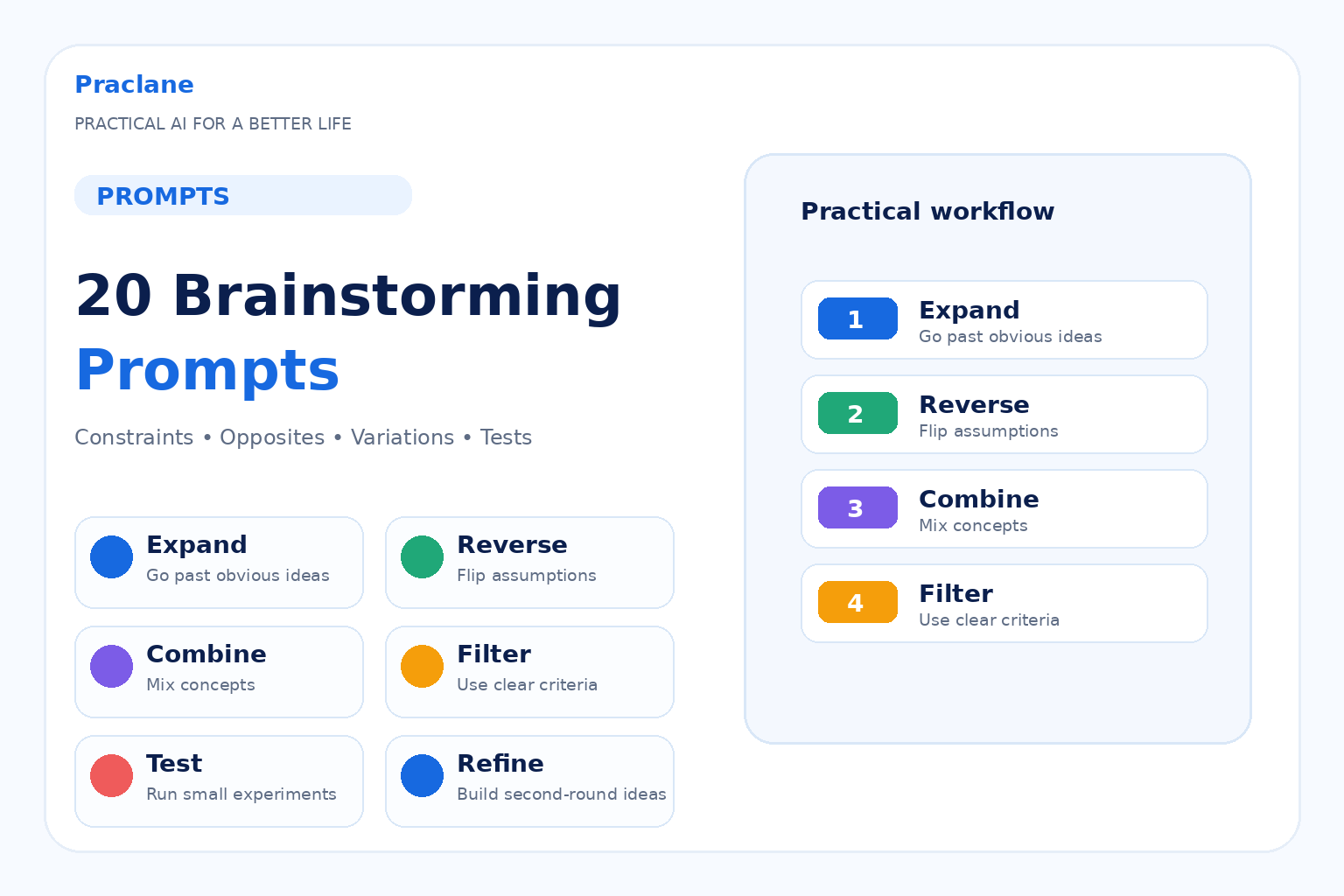
Better brainstorming comes from asking for different kinds of thinking: constraints, opposites, combinations, analogies, failure modes, audience shifts, and selection criteria.
These 20 ChatGPT prompts for brainstorming are designed to help you move beyond generic idea lists and toward ideas you can actually evaluate.
For prompt fundamentals, see our prompt-writing guide. For reusable structures across work and life, see our prompt template library.
1. Start With the Obvious Ideas—Then Ban Them
Give me the 10 most obvious ideas for [goal]. Then treat those ideas as banned and generate 15 alternatives that use a genuinely different approach.
2. Brainstorm Under a Hard Constraint
Generate 15 ideas for [goal] under these constraints: [budget], [time], [tools], [audience], and [things I cannot do]. Explain how each idea respects the constraints.
Constraints often produce more useful ideas because they eliminate options that are impossible in practice.
3. Create Ideas for Three Different Audiences
Generate ideas for [goal] for three audiences: beginner, experienced user, and expert. Make the ideas meaningfully different rather than changing only the wording.
4. Use the Opposite Assumption
List the main assumptions behind the usual approach to [problem]. Reverse each assumption and generate one idea that would make sense if the opposite were true.
This is useful when your first ideas all resemble existing solutions.
5. Combine Two Unrelated Concepts
Combine [concept A] and [concept B] to create 10 ideas for [goal]. For each idea, explain what element came from A, what came from B, and why the combination might be useful.
6. Borrow a Pattern From Another Industry
Choose five industries very different from [my field]. Identify one useful pattern from each and adapt that pattern into an idea for [problem]. Avoid superficial analogies.
7. Generate Ideas at Three Risk Levels
Generate ideas for [goal] in three groups: Low Risk, Moderate Risk, and Experimental. Give me five ideas in each group and explain what creates the risk.
8. Make the Idea Smaller
Take this idea: [idea]. Create 10 smaller versions that can be tested in one day, one week, or with a very small budget. Preserve the core learning goal.
Ideas become more useful when they can turn into experiments instead of remaining concepts.
9. Make the Idea More Extreme
Take this idea: [idea]. Create five deliberately extreme versions. Then identify which parts of those extremes could improve the realistic version.
10. Brainstorm Around a Specific Failure
Assume my current approach failed because of [failure]. Generate 12 ideas designed specifically to avoid or reduce that failure mode.
11. Use “What Would Make This Easier?”
Instead of asking how to achieve [goal] directly, brainstorm 15 ways to make achieving it easier, faster, cheaper, simpler, or more repeatable.
12. Generate Questions Before Generating Ideas
Do not give me ideas yet. Ask 10 questions that would materially change the quality of ideas for [goal]. Prioritize constraints, audience, success criteria, previous attempts, and what must not happen.
A better brainstorming session often starts with better questions, not more ideas.
13. Generate Ideas From Existing Strengths
My existing strengths and assets are [assets]. Generate 15 ideas for [goal] that use what I already have instead of assuming new resources.
14. Brainstorm From Customer or User Friction
Here are the frustrations people have with [process or product]: [frictions]. Generate ideas that remove, reduce, or redesign each friction. Show which friction each idea addresses.
15. Turn One Idea Into Variations
Take this idea: [idea]. Create variations by changing audience, format, channel, price, frequency, complexity, timing, and delivery method. Give me at least one meaningful variation for each dimension.
16. Ask for the Strongest Counter-Idea
Here is my preferred idea: [idea]. Generate the strongest competing idea that solves the same problem using a fundamentally different strategy. Then compare the trade-offs without choosing a winner.
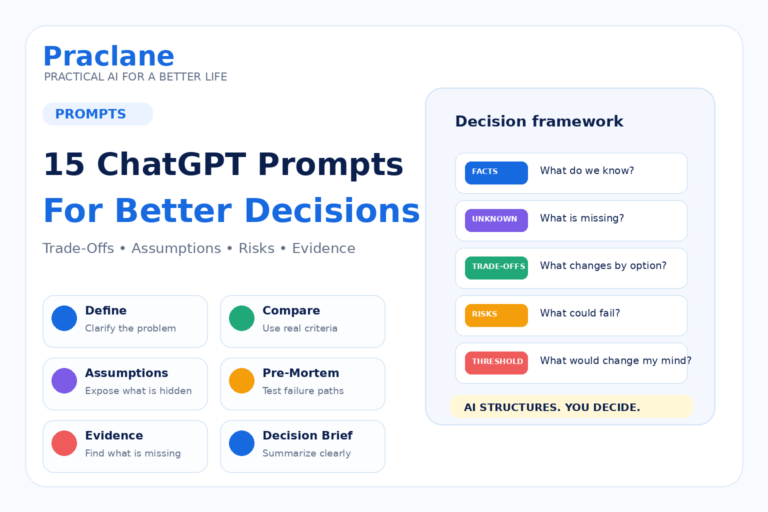
For more structured comparison, see our decision-making prompts.
17. Cluster a Large Idea List
Group these ideas into meaningful clusters based on underlying strategy, not surface wording. Name each cluster and explain what makes it distinct: [ideas]
18. Score Ideas Against Explicit Criteria
Evaluate these ideas using the criteria [criteria]. Do not give a final recommendation. Instead, show the trade-offs, missing information, and which criterion each idea handles well or poorly.
19. Turn the Best Ideas Into Tests
Take these three ideas: [ideas]. Design the smallest practical test for each. Include hypothesis, test action, time required, success signal, failure signal, and what I would learn.
20. Run a Second-Round Brainstorm
Here are my current ideas: [ideas]. Do not repeat or lightly rephrase them. Identify the patterns already covered, then generate 10 ideas from strategies that are currently missing.
A Reusable Brainstorming Prompt
I need ideas for [goal]. Context: [context]. Constraints: [constraints]. What I have already tried: [attempts]. What success looks like: [criteria]. First ask any questions that would materially change the ideas. Then generate a diverse set using different strategies. Group the ideas by approach, flag assumptions, and suggest a small test for the strongest candidates without making the final decision for me.
Common Brainstorming Mistakes
- Asking for “20 ideas” without context or constraints.
- Stopping after the first generic list.
- Generating more ideas when the real problem is unclear criteria.
- Letting every idea use the same underlying strategy.
- Evaluating ideas before enough diversity exists.
- Choosing an idea before testing the key assumption.
Frequently Asked Questions
Why are ChatGPT brainstorming ideas often generic?
Broad prompts encourage broadly applicable answers. Adding constraints, audience, prior attempts, desired outcomes, and a specific thinking method usually creates more differentiated ideas.
Should I ask for more ideas or better ideas?
Both can help, but after the first list it is often more useful to change the method—such as reversing assumptions or borrowing patterns—than simply increasing the number.
Can ChatGPT choose the best idea?
It can help structure criteria and compare trade-offs, but the final choice should reflect your goals, constraints, evidence, and preferences.
How do I avoid repeated ideas?
Give ChatGPT the existing list, ask it to identify the strategies already represented, and require new ideas to come from missing strategies instead of simple rewording.
Final Thoughts
Good brainstorming is not just idea quantity. It is deliberate variation in how the problem is viewed.
Change the constraints, reverse assumptions, combine patterns, test the strongest ideas, and use ChatGPT to expand the space before narrowing it.