ChatGPT Research Prompt Template: Search, Compare, Cross-Check, and Cite Sources
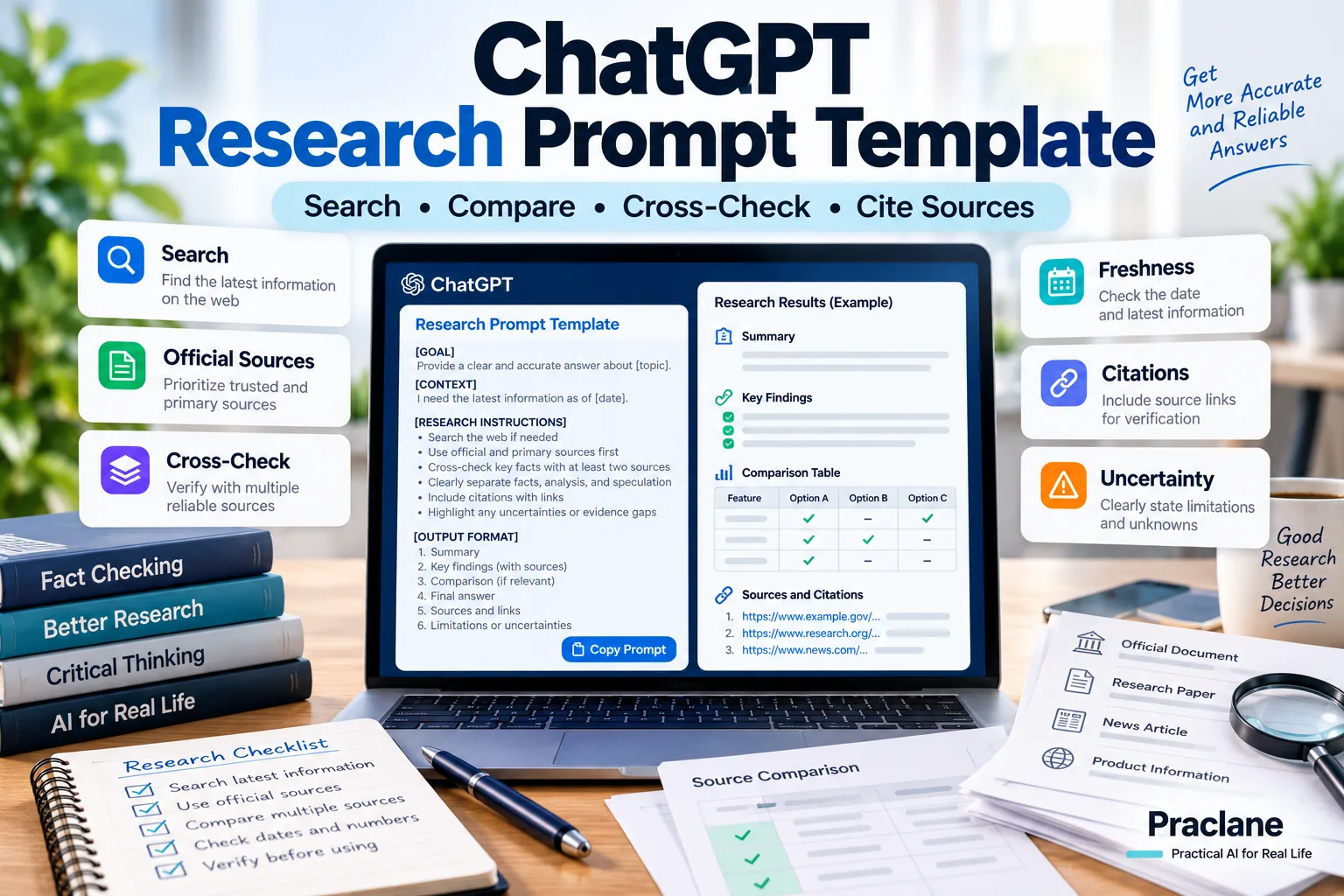
A good research prompt should do more than tell ChatGPT to “search the web.” It should define the question, the source standard, the time window, what must be cross-checked, how disagreements should be handled, and what the final research output should look like.
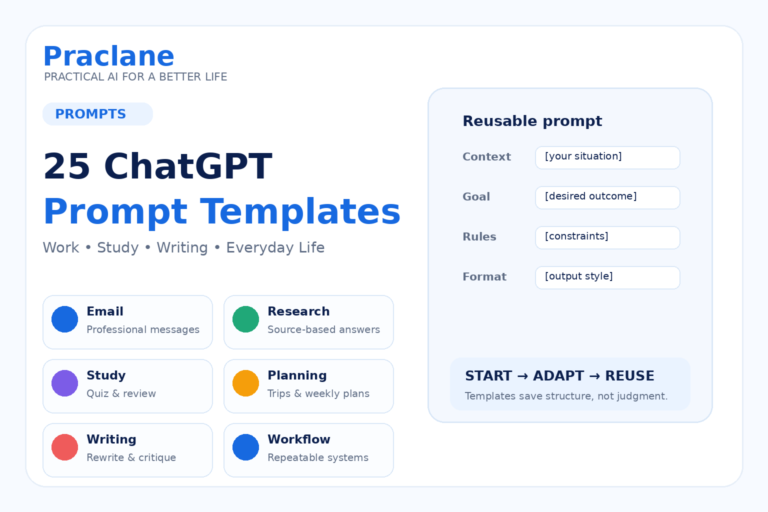
This ChatGPT research prompt template is designed for current information, comparisons, fact checking, product research, work research, travel research, and other tasks where you want the answer to be easy to verify.
Copy-Paste ChatGPT Research Prompt
RESEARCH GOAL
Research this question: [QUESTION OR DECISION].
CONTEXT
Use this context: [LOCATION, DATE RANGE, AUDIENCE, BUDGET, CONSTRAINTS, DEFINITIONS, OR BACKGROUND].
SEARCH STRATEGY
1. Determine what information must be current and search the web for those parts before answering.
2. Prefer official, primary, or first-party sources for rules, product features, prices, dates, policies, statistics, schedules, company claims, and technical details.
3. Use strong independent secondary sources for comparison, interpretation, or real-world context when they add value.
4. Do not rely on multiple pages that simply repeat the same underlying source as if they were independent confirmation.
5. For the most important claims, cross-check against another independent reliable source when practical.
FRESHNESS
Check publication and update dates. Make sure each time-sensitive claim matches the period I asked about. If an older source remains authoritative, explain why it is still relevant.
VERIFICATION
Recheck names, dates, prices, percentages, measurements, versions, deadlines, quotations, and calculations. Open cited sources and make sure they actually support the claim. Do not invent missing facts, citations, studies, or quotes.
DISAGREEMENT AND UNCERTAINTY
If trustworthy sources disagree, show the disagreement. Separate confirmed facts, reasonable inference, and unresolved uncertainty. Tell me what evidence is missing instead of guessing.
OUTPUT
Give me:
1. A concise answer or conclusion first.
2. A comparison or evidence table when useful.
3. The strongest evidence for each important point.
4. Key trade-offs, limitations, and exceptions.
5. Sources next to the claims they support.
6. A section called “What Still Needs Verification.”
MY QUESTION
[PASTE THE ACTUAL RESEARCH QUESTION HERE]
Why This Research Prompt Is Different
Many research prompts focus only on the output—“give me a report,” “make a comparison,” or “include citations.” This template also controls the research process.
- It tells ChatGPT when fresh web information matters.
- It defines a source hierarchy.
- It avoids treating copied articles as independent confirmation.
- It forces date checking.
- It separates facts from inference.
- It makes source disagreement visible.
- It ends with unresolved items instead of pretending the research is complete.
OpenAI’s current Search guidance recommends opening citations, checking that the source really supports the answer, reviewing publication or update dates, and using authoritative sources when accuracy matters.
When to Use Web Search vs Deep Research
| Use Web Search | Use Deep Research |
|---|---|
| One narrow current question | Several connected research questions |
| A few good sources are enough | Many sources must be compared |
| You need the answer quickly | You need a documented report |
| You can verify the answer in minutes | You want a research plan and deeper synthesis |
Our ChatGPT Web Search vs Deep Research comparison goes deeper into that choice.
Fast Version for Everyday Research
Research this using current web sources: [QUESTION]. Prefer primary or official sources, cross-check the important claims, check dates and numbers, and do not guess missing information. Separate confirmed facts from uncertainty. Give me the answer first, then the evidence and source links, and finish with anything I should verify myself.
Version for Product Comparison
Compare [PRODUCTS] for [USE CASE]. My priorities are [CRITERIA]. Use current manufacturer specifications and pricing as primary sources. Use independent sources only for real-world observations that manufacturers do not establish well. Check region and model version. Put the comparison in one table, explain the important trade-offs, and flag any specification or price that could not be independently verified.
Version for Current Rules or Policies
Research the current rules for [TOPIC] in [JURISDICTION]. Prioritize the responsible government agency or official regulator. State the effective date, scope, exceptions, deadlines, and official source. Use secondary sources only for explanation. If the official text is ambiguous or does not answer the question, say so rather than filling the gap.
Version for Fact Checking a Claim
Fact-check this claim: [CLAIM]. Find the original or strongest primary source. Identify exactly what it says, the relevant date and scope, and whether the claim accurately represents it. Then look for independent reliable evidence that confirms, qualifies, or contradicts the claim. Finish with Supported, Misleading, Unclear, or Unsupported, followed by the evidence.
Version for Work or Market Research
Research [MARKET / COMPANY / TOOL / TOPIC] for a decision by [AUDIENCE]. Cover [RESEARCH QUESTIONS]. Use current first-party sources for factual company or product claims and independent sources for market context. Compare evidence consistently across the same criteria. Identify missing data, conflicting claims, and assumptions. End with implications, risks, and the next research steps—not a recommendation unless the evidence supports one.
Add a Source Hierarchy
For difficult research, tell ChatGPT what source types should carry the most weight.
- Official or primary source
- Original research or direct documentation
- High-quality independent reporting or expert analysis
- Community or user experience, clearly labeled as anecdotal
This prevents a polished blog post from being treated as stronger evidence than the underlying regulation, specification, filing, or study.
Add a Time Window
“Latest” is often too vague. Define the window when freshness matters.
Use information current as of [DATE]. For recent developments, prioritize sources from the last [7 / 30 / 90] days. Older official sources are acceptable when they are still the controlling or authoritative reference.
Ask for Evidence, Not Just Citations
A link beside a sentence is not enough. The source must actually support the claim.
For every important conclusion, state which source supports it and what that source establishes. Do not cite a page if it only discusses the topic generally but does not support the specific claim.
What to Do When Sources Disagree
If two reliable sources disagree, do not silently choose one. Show both positions, explain whether they apply to different dates, populations, regions, definitions, or methods, and tell me which disagreement remains unresolved.
Pair It With the Universal Template
If you need a broader prompt that also covers non-research tasks, start with our Universal ChatGPT Prompt Template for accurate, search-backed answers. Use this research-specific version when the main value comes from finding and comparing external evidence.
What This Prompt Cannot Guarantee
- A source can still be wrong or outdated.
- A model can misunderstand a source.
- Some evidence may be inaccessible or missing online.
- Search results can omit relevant material.
- Two “independent” sources may rely on the same original dataset.
- High-impact decisions may still require official or professional confirmation.
Official Sources
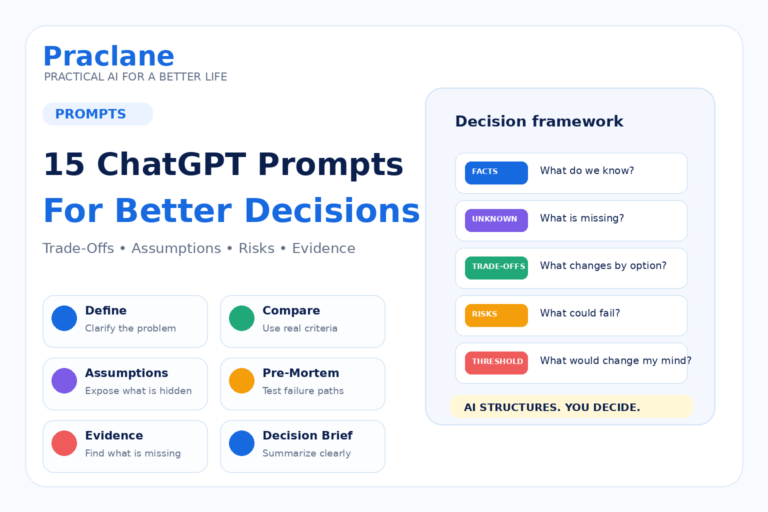
If the research goal is specifically to choose between several options, continue with our ChatGPT Comparison Prompt Template for consistent criteria, verified facts, missing-data checks, and trade-offs.
Final Thoughts
Research quality improves when you control both the question and the evidence standard. A useful research prompt tells ChatGPT what to search, which sources to trust first, what to cross-check, how to handle disagreement, and what must remain explicitly uncertain.