Universal ChatGPT Prompt Template for Accurate, Search-Backed, Verifiable Answers
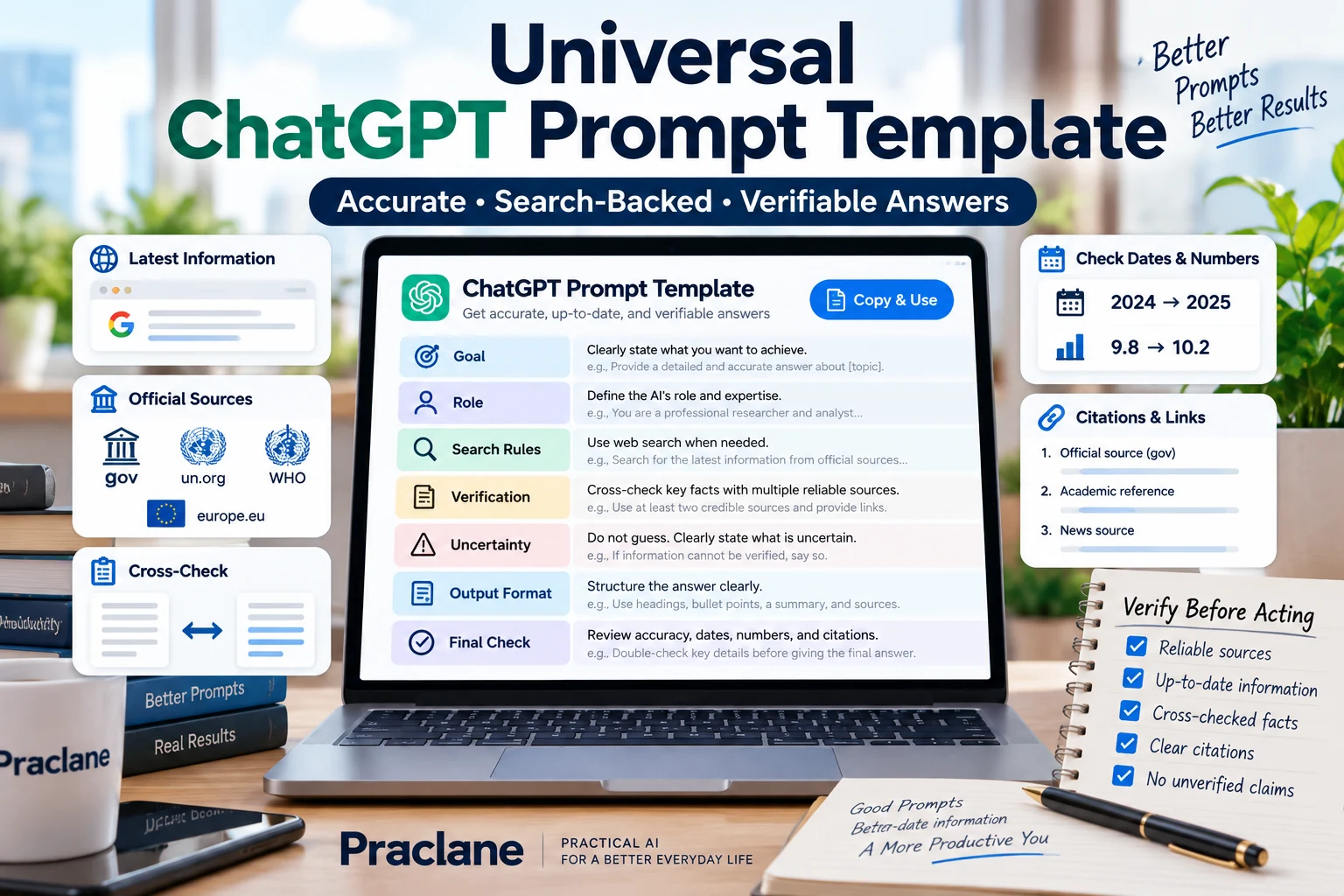
Most weak AI answers are not caused by one missing “magic phrase.” They happen because the request does not clearly define the goal, the evidence standard, what needs current information, how uncertainty should be handled, or what the final answer should look like.
This page gives you one universal ChatGPT prompt template designed for situations where you care about accuracy, search quality, source quality, verification, and clear uncertainty.
You can copy it as-is, then replace the bracketed sections for research, purchases, travel, work, learning, comparisons, planning, and everyday decisions.
Copy-Paste Universal Prompt Template
GOAL
Help me accomplish this objective: [DESCRIBE THE RESULT YOU NEED].
CONTEXT
Relevant background: [ADD CONTEXT, LOCATION, DATE RANGE, AUDIENCE, BUDGET, CONSTRAINTS, OR SOURCE MATERIAL].
ACCURACY AND SEARCH RULES
1. First determine whether this request depends on current, changing, external, or location-specific information. If it does, search the web before answering. If it does not, do not search unnecessarily.
2. Prefer official, primary, or first-party sources for rules, prices, product features, policies, statistics, schedules, laws, research, and other factual claims whenever practical.
3. Use secondary sources when they add useful explanation, comparison, or independent confirmation.
4. For important claims, cross-check with another independent reliable source when practical.
5. Check publication or update dates and make sure the evidence matches the time period and population I asked about.
6. Recheck names, dates, prices, percentages, measurements, version numbers, deadlines, quotes, and calculations before presenting them.
7. Do not invent missing information, citations, quotations, studies, features, or sources.
REASONING AND UNCERTAINTY
Separate: (a) confirmed facts, (b) reasonable inference, and (c) unresolved uncertainty. If trustworthy sources disagree, explain the disagreement and do not force a single conclusion. If the evidence is insufficient, say what is missing.
ANSWER QUALITY
Focus on my actual decision or goal instead of giving a generic overview. Prioritize the most useful information. Explain important trade-offs, limitations, exceptions, and risks. Ask a clarifying question only when missing information would materially change the answer.
OUTPUT
Give me:
1. A concise answer first.
2. The key evidence or reasoning.
3. A practical recommendation or next step when appropriate.
4. Sources next to the claims they support when web research is used.
5. A final section called “Verify Before Acting” listing any facts I should independently confirm because they are high-impact, uncertain, or likely to change.
MY REQUEST
[PASTE YOUR ACTUAL QUESTION OR TASK HERE]
Why This Template Works Better Than “Be Accurate”
“Be accurate” is vague. The template above gives the model operational instructions:
- Decide whether fresh information is required.
- Search only when search adds value.
- Prefer authoritative sources.
- Cross-check important claims.
- Check dates and scope.
- Separate fact from inference.
- State uncertainty instead of hiding it.
- Produce an answer built around your decision.
OpenAI’s current prompting guidance recommends clear, specific requests with enough context, while its Search guidance explicitly recommends opening cited sources, checking whether they really support the answer, and using authoritative sources when accuracy matters.
What to Replace Before You Use It
| Placeholder | What to Add | Example |
|---|---|---|
| [DESCRIBE THE RESULT YOU NEED] | The decision or deliverable | Choose the best carry-on suitcase for weekly travel |
| [CONTEXT] | Facts that change the answer | South Korea, budget under $250, frequent international flights |
| [DATE RANGE] | Freshness requirement | Current as of September 2026 |
| [CONSTRAINTS] | Limits or must-have conditions | Under 3 kg, 4 wheels, available online |
| [MY REQUEST] | Your actual question | Compare three strong options and explain the trade-offs |
Example 1: Product Research
Help me choose a robot vacuum for an apartment with a dog. My budget is $700. I care most about hair pickup, obstacle avoidance, maintenance cost, and replacement-part availability. Use the universal accuracy rules above. Search current manufacturer specifications and at least one independent source. Compare no more than four products. Separate verified specifications from reviewer observations, and flag any feature that varies by region or model version.
This is stronger than “What robot vacuum should I buy?” because the answer has a clear objective, budget, evaluation criteria, source rules, and scope.
Example 2: Travel Research
I am planning a five-day trip to Madrid in November 2026. Build a practical itinerary around food, walkable neighborhoods, and major first-time attractions. Verify current opening days and reservation requirements using official attraction websites where possible. Do not assume opening hours. Clearly mark anything that should be rechecked shortly before the trip.
Example 3: Work Research
Research the current differences between these three software plans for a 20-person team. Use the vendors’ official pricing and documentation as primary sources. Check the date and region of every price. Separate included features from optional add-ons. If documentation conflicts, show the conflict. End with a decision table based on our priorities: security, administration, integrations, and total annual cost.
Example 4: Learning
Teach me [TOPIC] at an introductory level. Before answering, identify which parts are stable knowledge and which parts may require current sources. Explain the concept in plain language, then give one worked example, three retrieval-practice questions, and the common mistakes beginners make. If you use factual claims that could have changed, verify them before including them.
Quick Version for Everyday Questions
Answer this accurately and practically. Search the web if the answer depends on current or external information. Prefer primary sources, cross-check important claims, check dates and numbers, separate confirmed facts from uncertainty, and do not guess missing information. Give the answer first, then evidence and sources, and finish with anything I should verify before acting. My request: [QUESTION]
Use the quick version when the full template would be overkill.
Stricter Version for High-Impact Research
For legal, medical, financial, safety, immigration, tax, or other high-impact topics, a prompt can improve research discipline but it does not make ChatGPT the final authority. Add this block:
This is a high-impact topic. Do not make a final professional judgment for me. Prioritize official and primary sources, state the jurisdiction and effective date where relevant, identify exceptions, and clearly separate general information from anything that requires a qualified professional or official confirmation.
How to Make the Template More Efficient
- Delete rules that do not matter for the task.
- Give the decision criteria before asking for recommendations.
- Set a maximum number of options.
- Tell ChatGPT what not to do.
- Specify the desired format: table, checklist, brief, plan, or step-by-step guide.
- For long source material, separate your instructions from the material clearly.
OpenAI’s prompt-engineering guidance recommends being clear and specific, supplying relevant context, describing the desired output, and refining prompts iteratively when the first result is not sufficient.
What This Prompt Cannot Guarantee
- A model can still misunderstand a source.
- A cited page can still be outdated or wrong.
- Not every search result is complete.
- Two sources can repeat the same underlying error.
- The most authoritative source may not be available online.
- High-impact decisions may still require professional or official confirmation.
OpenAI itself recommends reviewing citations, opening the source, checking when it was published or updated, and confirming that it actually supports the answer.
Pair This Template With a Verification Workflow
A strong prompt improves the first answer. Verification improves what happens after the answer. For the second half of the process, use our guide to verifying ChatGPT answers.
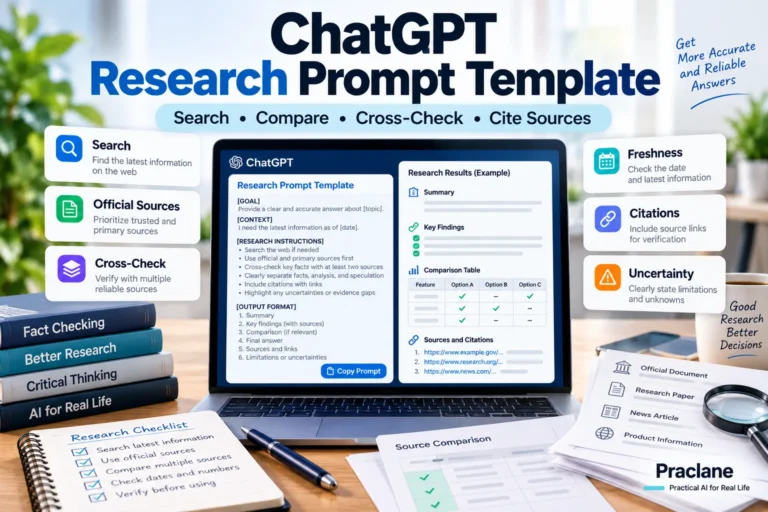
You can also browse our reusable ChatGPT prompt templates for task-specific starting points. For web research specifically, use our ChatGPT Research Prompt Template to control search, source quality, cross-checking, citations, and uncertainty.
Official Sources
- Prompt engineering best practices for ChatGPT
- How do I create a good prompt for an AI model?
- Searching the web with ChatGPT
If the task is specifically turning a goal into a realistic roadmap, use our ChatGPT Planning Prompt Template for phases, dependencies, priorities, risks, checkpoints, and next actions.
For communication tasks, use our ChatGPT Email Prompt Template to control recipient context, tone, facts, boundaries, and the requested next action.
Final Thoughts
The best universal prompt is not the longest prompt. It is the one that defines the goal, tells ChatGPT when fresh evidence is required, sets a source and verification standard, makes uncertainty visible, and produces an answer you can actually use.