How to Use ChatGPT for Excel: 12 Practical Workflows
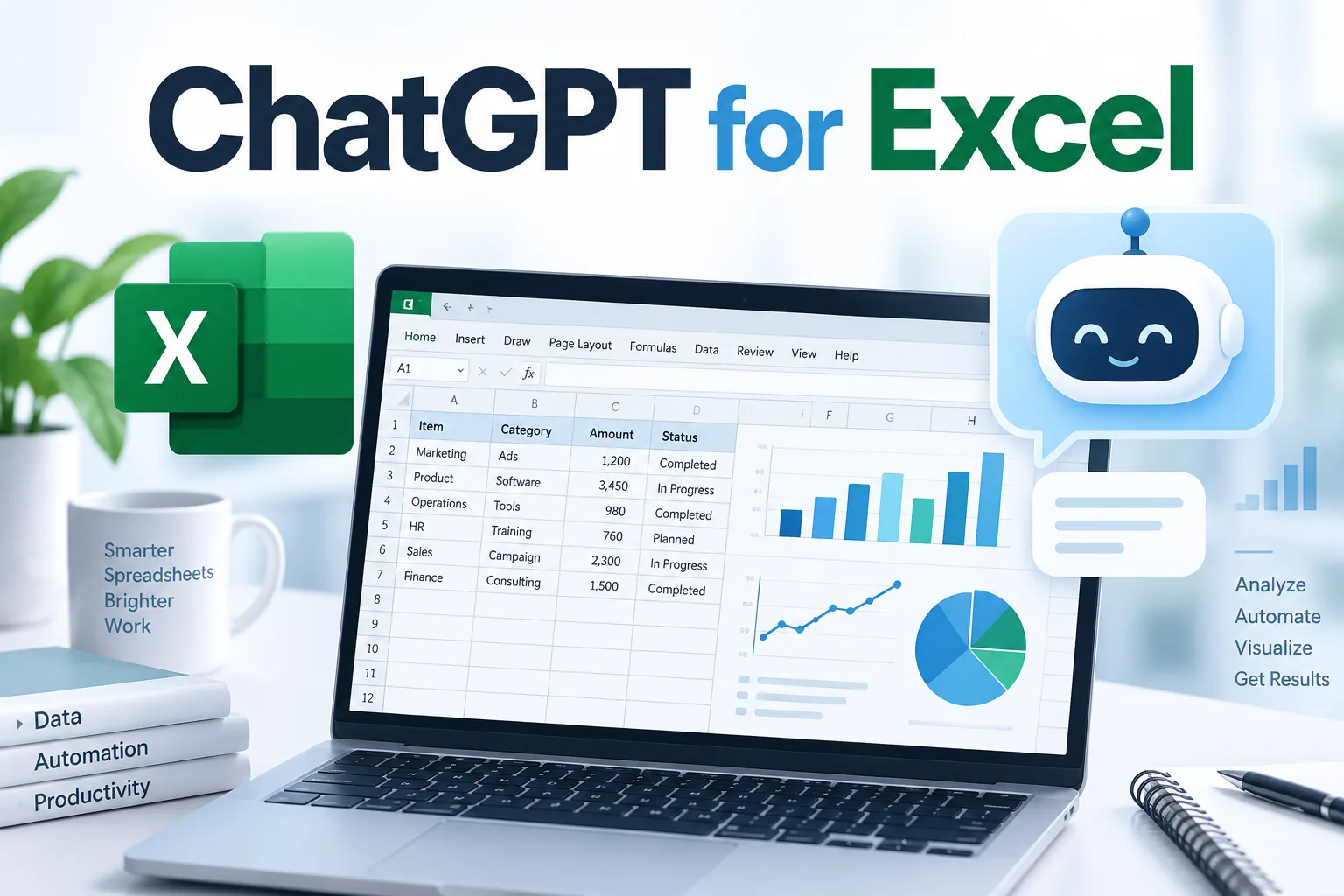
Excel is powerful, but a large part of spreadsheet work is repetitive: writing formulas, fixing errors, cleaning columns, checking totals, comparing tabs, building charts, and turning raw data into a report.
This guide shows how to use ChatGPT for Excel with 12 practical workflows you can reuse for everyday spreadsheet work. It covers both ways people commonly work today: uploading an Excel file to ChatGPT for analysis, and using ChatGPT directly inside Excel when the spreadsheet integration is available.
If you want broader workplace ideas first, start with our guide to using ChatGPT for work. If your prompts often produce vague answers, see how to write better ChatGPT prompts.
The Two Main Ways to Use ChatGPT With Excel
There is no single “ChatGPT for Excel” workflow. The right method depends on whether you want ChatGPT to analyze a file in chat or work directly with a workbook.
| Method | Best For | How It Works |
|---|---|---|
| Upload the workbook to ChatGPT | Analysis, summaries, charts, data cleaning, one-off questions | Upload an .xlsx, .xls, or .csv file and ask questions in plain language |
| Use ChatGPT inside Excel | Editing, formulas, workbook updates, multi-tab work | Use the ChatGPT for Excel spreadsheet experience when available for your account or workspace |
OpenAI’s current data analysis documentation says ChatGPT can work with spreadsheet formats including XLS, XLSX, and CSV, and can create tables, charts, calculations, transformations, and statistical analysis from uploaded data.
OpenAI also provides ChatGPT for Excel and Google Sheets, which can help build, update, explain, and review spreadsheets directly in those tools. Availability can depend on your plan, account, workspace settings, and administrator controls.
Before You Start: Make the Spreadsheet Easy to Read
ChatGPT works best when the structure is clear. OpenAI recommends descriptive column names, one record per row, and avoiding unrelated tables mixed together on the same sheet.
- Use clear headers such as Order Date, Customer, Revenue, and Status.
- Avoid blank rows in the middle of a data table.
- Keep one type of record per row.
- Tell ChatGPT which sheet, columns, date range, or calculation matters.
- For important workbooks, say what must not be changed.
For example, “analyze this spreadsheet” is vague. A better request is: “Use the Sales sheet. Compare monthly revenue by region, identify the three biggest month-over-month declines, and show the result in a table.”
12 Practical Ways to Use ChatGPT for Excel
1. Understand an Unfamiliar Workbook
A spreadsheet can be difficult to understand when it has many tabs, formulas, assumptions, and references. Ask ChatGPT to explain the structure before making changes.
Review this workbook and explain what each sheet appears to do. Identify the main input cells, output tables, important formulas, and dependencies between tabs. Do not change anything yet.
This is especially useful when you inherit a workbook from someone else or return to a model you have not opened in months.
2. Write Excel Formulas From Plain English
You do not need to remember every Excel function. Describe the result you want, the relevant columns, and any conditions.
Write an Excel formula for row 2 that returns “Overdue” when the due date in D2 is earlier than today and the status in E2 is not “Complete.” Otherwise return a blank cell. Explain the formula briefly.
For better results, tell ChatGPT which Excel version you use when a formula depends on newer functions such as XLOOKUP, FILTER, LET, or dynamic arrays.
3. Fix a Broken Formula
If a formula returns the wrong result or an error such as #N/A, #VALUE!, or #REF!, paste the formula and explain what you expected.
This formula returns #N/A: [paste formula]. Column A contains customer IDs and Sheet2 column A contains the lookup list. I want the matching customer tier from Sheet2 column C. Diagnose the problem and give me the corrected formula.
Do not stop at the corrected formula. Ask ChatGPT to explain why the original failed so you can recognize the same problem later.
4. Clean Messy Spreadsheet Data
Real spreadsheets often contain inconsistent date formats, duplicate rows, extra spaces, mixed capitalization, missing values, or numbers stored as text.
Inspect this dataset for duplicates, inconsistent date formats, blank required fields, extra spaces, inconsistent category names, and numbers stored as text. Summarize the problems first. Then suggest a cleanup plan before changing anything.
Asking for the problems first is useful because automatic cleanup can sometimes remove something that was intentionally different.
5. Compare or Reconcile Two Sheets
ChatGPT can help compare two lists, find missing records, or identify mismatched values between tabs.
Compare the Orders and Payments sheets using Order ID as the key. Show orders that have no payment record, payments that have no matching order, and rows where the amount differs. Put the results into three separate tables.
This workflow can be useful for inventory checks, payment reconciliation, project tracking, and customer lists.
6. Summarize KPIs and Trends
Instead of manually scanning rows, ask ChatGPT to group the data and identify the numbers that matter.
Analyze the Sales sheet. Show monthly revenue, average order value, total orders, and the five largest customers. Then identify the strongest and weakest month and explain the main drivers visible in the data.
For recurring reporting, you can turn the same structure into a reusable process. Our guide to using ChatGPT for recurring reports shows how to keep the format stable while the data changes each week or month.
7. Find Outliers and Unusual Values
Large datasets can hide errors or unusual activity. Ask ChatGPT to flag values that deserve review rather than simply listing the largest numbers.
Review this expense dataset for unusual values. Flag transactions that are extreme compared with the normal range for their category, duplicate-looking payments, and sudden changes by month. Explain why each item was flagged.
An outlier is not automatically an error. Treat the result as a review list, not a final conclusion.
8. Create Charts That Match the Question
Do not ask only for “a chart.” Tell ChatGPT what decision or comparison the chart should support.
Create a chart that makes it easy to compare monthly revenue for the four regions. Recommend the most appropriate chart type, explain why, and keep the visual simple enough for a management report.
When analyzing uploaded spreadsheet data, ChatGPT can create visualizations directly. When working inside Excel, the available spreadsheet experience may also help build or update charts in the workbook.
9. Run What-If and Scenario Analysis
Spreadsheets are often used to answer questions such as “What happens if price rises 5%?” or “How much cash do we need if sales fall?” ChatGPT can help structure those scenarios.
Use the current model as the base case. Create three scenarios: sales -10%, base case, and sales +10%. Keep fixed costs unchanged and assume variable costs remain the same percentage of sales. Show the effect on revenue, gross profit, and operating profit.
For financial models, verify assumptions and formulas carefully before using the result for a real decision.
10. Turn Spreadsheet Data Into a Written Report
After the analysis is finished, ask ChatGPT to translate the numbers into a short summary for a specific audience.
Use the analysis in this workbook to write a 200-word weekly operations summary for a department manager. Include the three most important changes, one risk, one positive development, and two actions to review next week. Do not invent explanations that are not supported by the data.
This keeps the spreadsheet as the source while using ChatGPT to make the findings easier to communicate.
11. Build a Spreadsheet From Scratch
If you know the goal but not the structure, ask ChatGPT to design the workbook before filling it with formulas.
Create a simple project tracker for a 10-person team. Include Task, Owner, Start Date, Due Date, Status, Priority, Days Remaining, and Notes. Add formulas for overdue status and a summary section showing total tasks, completed tasks, overdue tasks, and completion rate.
The same approach works for budgets, inventory trackers, content calendars, sales pipelines, checklists, and planning templates.
12. Review the Workbook Before You Trust It
AI-assisted spreadsheet work still needs quality control. Ask ChatGPT to perform a second-pass review focused on errors rather than creation.
Audit this workbook without changing it. Check for broken formulas, inconsistent formulas within the same column, hard-coded values inside formula ranges, totals that do not reconcile, suspicious blanks, and references to missing sheets. Return a review checklist with the affected cells.
For important numbers, independently verify the workbook. Our guide to verifying ChatGPT answers explains a practical checking process you can use before relying on AI-generated conclusions.
A Simple Prompt Formula for Excel
For most spreadsheet tasks, give ChatGPT five pieces of information:
- Workbook context: what the spreadsheet is for.
- Relevant location: sheet names, columns, cells, or tables.
- Goal: what result you want.
- Constraints: what must stay unchanged.
- Output: formula, table, chart, summary, or list of changes.
This workbook tracks customer orders. Use the Orders sheet only. Column B is Region, column F is Revenue, and column G is Order Date. Calculate monthly revenue by region for 2026, show the result in a table, and create a chart. Do not modify the raw data.
That gives ChatGPT far more useful information than “analyze my Excel file.”
Common Mistakes When Using ChatGPT for Excel
- Giving too little context. A formula request is much easier to solve when you provide column names, example rows, and the expected result.
- Letting AI make large edits without a plan. For important workbooks, ask what will be changed before allowing edits.
- Ignoring Excel version differences. Some functions are not available in older versions.
- Trusting every formula immediately. Test new formulas on a few known examples before filling an entire column.
- Uploading unnecessary sensitive data. Follow your employer’s privacy and AI-use policies.
- Using AI to automate a bad process. Fix the underlying workflow before making it repeatable.
If the spreadsheet task repeats every week or month, you may also want our guide to automating repetitive tasks with ChatGPT.
What Should You Avoid Uploading?
Do not upload passwords, authentication codes, private keys, unnecessary personal information, confidential customer data, or restricted company information just because it appears in a workbook.
For workplace spreadsheets, follow your organization’s security, privacy, retention, and AI policies. If the analysis does not require identifying information, remove or anonymize it before sharing the file.
Frequently Asked Questions
Can ChatGPT open Excel files?
Yes. OpenAI currently supports common spreadsheet formats including XLS, XLSX, and CSV for data analysis, subject to account and feature availability.
Can ChatGPT work directly inside Excel?
OpenAI offers ChatGPT for Excel as a spreadsheet-native experience that can help build, update, and understand workbooks. Availability can depend on your account, plan, workspace settings, and administrator controls.
Can ChatGPT write Excel formulas?
Yes. Describe the result you need, identify the relevant cells or columns, and specify any conditions. Always test important formulas with known examples before applying them broadly.
Can ChatGPT create charts from Excel data?
Yes. ChatGPT can create charts from uploaded data when a visualization is useful, and spreadsheet-native workflows may also help create or update charts in the workbook.
Is ChatGPT reliable for financial spreadsheets?
It can help with analysis, formulas, scenarios, and review, but important financial calculations should be independently checked. AI can make mistakes, misunderstand assumptions, or change the wrong cells if the request is ambiguous.
To see how prompt design changes spreadsheet analysis quality, compare our same-spreadsheet test of summary, diagnostic, and decision-support workflows.
Final Thoughts
The biggest advantage of using ChatGPT with Excel is not avoiding spreadsheets. It is reducing the time spent on repetitive spreadsheet mechanics so you can focus on the question the data is supposed to answer.
Start with one low-risk task: explain an unfamiliar formula, clean a small table, summarize a dataset, or build a simple report. Once the workflow is reliable, turn it into a repeatable process.
For the broader workflow, continue with 15 practical ways to use ChatGPT at work, build a reusable reporting process with our recurring reports guide, or turn spreadsheet findings into a presentation with our ChatGPT for PowerPoint guide.