15 ChatGPT Prompts for Better Decisions and Problem Solving
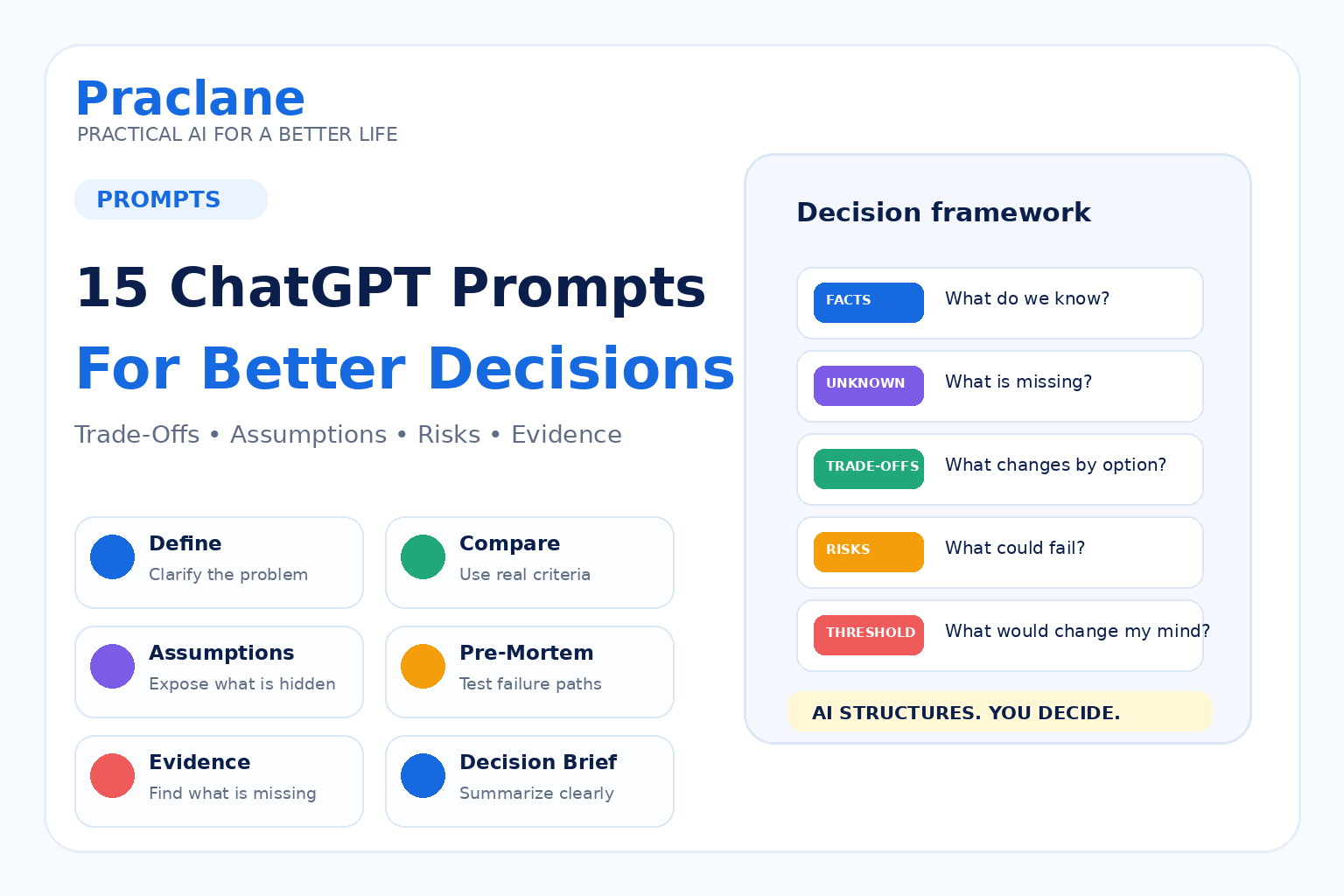
Good decisions are rarely about finding one clever answer. They are about clarifying the problem, comparing trade-offs, checking assumptions, and seeing what information is still missing.
ChatGPT can help structure that process, but it should not make important decisions for you.
This guide gives you 15 reusable ChatGPT prompts for decision-making and problem solving that help you think more clearly without outsourcing judgment.
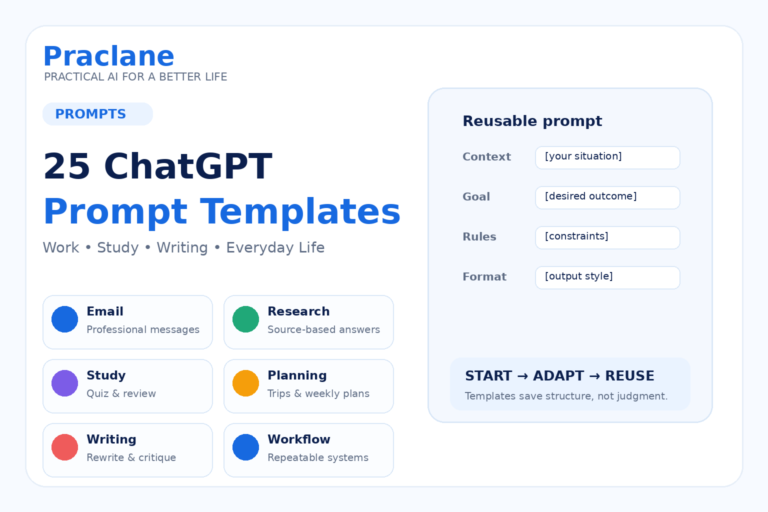
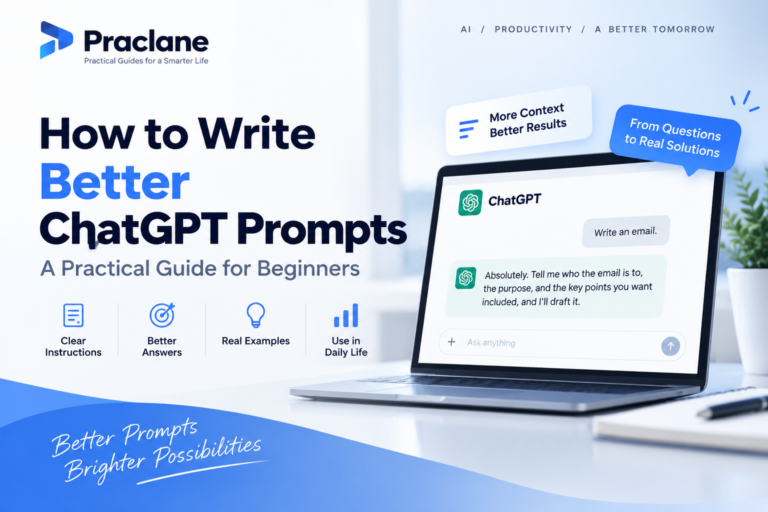
If you want the general principles behind stronger prompts, see our prompt-writing guide. For a broader reusable library, see our 25 ChatGPT prompt templates.
Before You Use AI for a Decision
Use ChatGPT to organize facts, expose blind spots, and test your reasoning. For decisions involving health, legal rights, money, safety, or other high-stakes consequences, verify critical facts with qualified sources before acting.
A useful AI decision prompt should make uncertainty more visible—not hide it behind a confident answer.
1. Define the Real Problem
Help me define this problem clearly: [situation]. Separate the symptoms from the underlying problem. List what is known, unknown, assumed, and outside my control. Do not suggest solutions yet.
2. Compare Options With Explicit Criteria
Compare [option A], [option B], and [option C] for this goal: [goal]. Use these criteria: [criteria]. Show the trade-offs under each criterion, identify missing information, and do not choose for me.
This works better than simply asking, “Which option is best?” because it forces the comparison to stay tied to your real priorities.
3. Surface Hidden Assumptions
Review this plan or decision: [plan]. List the assumptions it depends on. For each assumption, tell me what evidence would support it, what would weaken it, and how important it is to the outcome.
4. Identify Missing Information
I need to decide whether to [decision]. Here is what I know: [facts]. Before analyzing the options, list the five pieces of missing information that could most change the decision.
5. Run a Pre-Mortem
Assume this plan failed six months from now: [plan]. Give me the most plausible reasons, the earliest warning sign for each, and one preventive action. Focus on realistic operational risks rather than extreme scenarios.
A pre-mortem is useful because it asks what could go wrong before failure becomes expensive.
6. Find the Strongest Counterargument
My current view is: [position]. Give me the strongest reasonable counterargument. Do not create a weak straw man. Tell me what evidence would make the counterargument stronger or weaker.
7. Separate Reversible and Irreversible Decisions
Break this decision into reversible and hard-to-reverse parts: [decision]. For reversible parts, suggest a small test. For hard-to-reverse parts, list what should be verified before committing.
8. Design a Small Experiment
Instead of committing fully to [idea], design a low-cost experiment I can run for [time period]. Define the hypothesis, test, success criteria, failure criteria, and what I should learn before deciding what to do next.
9. Break a Complex Problem Into Smaller Decisions
Break this problem into smaller decisions in the order I should resolve them: [problem]. Show dependencies between the decisions and identify which one should be answered first because it changes the others.
10. Distinguish Facts From Preferences
Analyze this decision: [decision]. Separate objective facts, estimates, assumptions, personal preferences, and emotional concerns. Do not dismiss the preferences or emotions; just label them clearly so I can see what kind of factor each one is.
11. Build a Decision Checklist
Create a short decision checklist for [decision]. Include the facts I need to verify, the risks I need to accept, the people I need to consult, the constraints I need to confirm, and a final review question before I commit.
12. Compare Short-Term and Long-Term Effects
For each option in this decision, separate the likely short-term effects from the possible 1-year and 3-year effects. Mark which points are facts, estimates, or speculation: [options]
13. Ask What Would Change Your Mind
My current preferred option is [option]. Help me define what new evidence, cost, delay, risk, or constraint would be strong enough to change my mind. Turn those into clear decision thresholds.
14. Review a Decision After the Fact
Help me review this past decision: [decision]. Separate the quality of the decision process from the final outcome. Identify what information I had at the time, what I missed, what was unpredictable, and what I should repeat or change next time.
A good outcome does not always mean the decision process was good, and a bad outcome does not always mean the process was poor.
15. Turn the Analysis Into a Human Decision Brief
Summarize this decision analysis into one page with: Goal, Options, Key Facts, Unknowns, Trade-Offs, Main Risks, Reversible Tests, and Questions I Still Need to Answer. Do not give me a final recommendation unless I explicitly ask for one.
A Reusable Decision-Making Prompt
Help me think through this decision: [decision]. My goal is [goal]. Options are [options]. Constraints are [constraints]. First separate facts, assumptions, unknowns, and preferences. Then compare trade-offs using [criteria], identify the strongest risks and counterarguments, and tell me what information would most improve the decision. Do not make the final choice for me.
Common Decision-Prompt Mistakes
- Asking “What should I do?” before defining the goal.
- Giving only one side of the situation and expecting a balanced analysis.
- Using criteria that do not reflect your real priorities.
- Treating estimates as facts.
- Ignoring information that could change the decision.
- Asking AI to choose when the real issue is a personal value judgment.
- Skipping verification when the decision has high consequences.
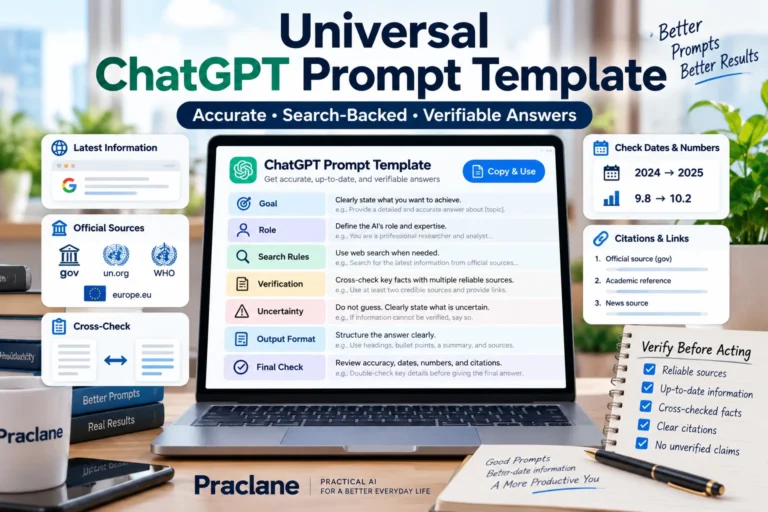
For important factual claims, use the process in our guide to verifying ChatGPT answers.
Frequently Asked Questions
Can ChatGPT help me make decisions?
Yes. It is useful for structuring options, trade-offs, assumptions, risks, and missing information. The final choice should remain yours, especially when values or high-stakes consequences are involved.
Can ChatGPT compare pros and cons?
Yes, but the result is more useful when you provide explicit criteria, constraints, and facts instead of asking for a generic pros-and-cons list.
Should I ask ChatGPT for a recommendation?
You can ask for analysis, but for important choices it is often better to ask what information, trade-offs, and thresholds matter before asking for a recommendation.
If the problem is generating stronger options before you evaluate them, use our ChatGPT brainstorming prompts.
When the decision is choosing between products, tools, plans, or services, use our ChatGPT Comparison Prompt Template to compare the same criteria, verify current facts, and expose trade-offs.
Final Thoughts
The best decision prompts do not make the decision disappear. They make the reasoning easier to inspect.
Use ChatGPT to clarify the problem, challenge the assumptions, and expose the trade-offs—then make the decision yourself.