ChatGPT Comparison Prompt Template: Compare Products, Tools, Plans, and Options Fairly
“Compare A and B” sounds simple, but weak comparisons often fail in predictable ways: the criteria change halfway through, current prices are mixed with old information, marketing claims are treated as facts, and one option gets more detail than the others.
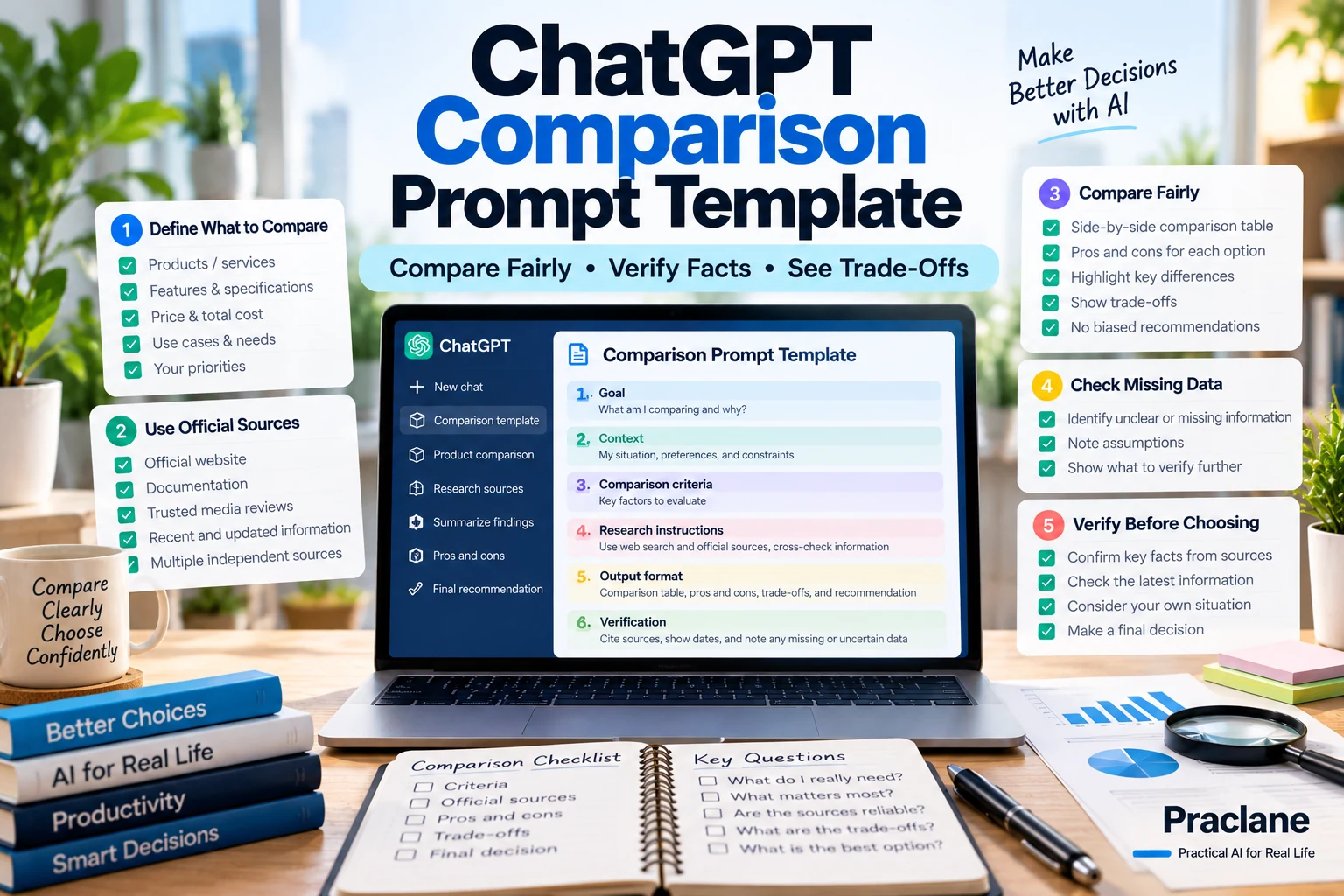
This ChatGPT comparison prompt template is designed to make comparisons more consistent, current, and verifiable—whether you are comparing products, software, plans, services, travel options, or other choices.
Copy-Paste ChatGPT Comparison Prompt
DECISION
I need to compare: [OPTION A], [OPTION B], [OPTION C].
My actual goal is: [WHAT I AM TRYING TO CHOOSE OR ACCOMPLISH].
CONTEXT
My location/region: [REGION].
Budget or limits: [BUDGET / CONSTRAINTS].
My priorities, in order: [CRITERIA].
Deal-breakers: [MUST-HAVE / MUST-NOT-HAVE].
COMPARISON RULES
1. Use the same evaluation criteria for every option.
2. If information may have changed, search the web before comparing it.
3. Prefer official or first-party sources for specifications, included features, pricing, policies, limits, availability, and warranty/terms.
4. Use independent sources for real-world observations such as usability, reliability, comfort, or support quality when useful.
5. Separate verified facts from reviewer opinion, user anecdotes, and your own inference.
6. Check that model names, plan tiers, regions, dates, and versions actually match.
7. Do not fill missing information with guesses. Mark it as Not Verified.
8. If sources disagree, show the disagreement.
SCORING
Do not invent an overall score unless I explicitly ask for one. Compare the options criterion by criterion. Show trade-offs rather than forcing a winner.
OUTPUT
Give me:
1. A short summary of the meaningful differences.
2. One comparison table using the same criteria for every option.
3. The strongest fit for each type of user or situation, without pretending one option is best for everyone.
4. Important trade-offs, hidden costs, limits, and uncertainties.
5. Source links beside time-sensitive or factual claims.
6. A “Verify Before Buying/Choosing” section for anything likely to change.
OPTIONS TO COMPARE
[PASTE OPTIONS OR LINKS HERE]
Why This Template Produces Fairer Comparisons
- It defines your goal before the comparison starts.
- It fixes the criteria so every option is measured the same way.
- It separates manufacturer claims from independent observations.
- It forces region, model, plan, and date checks.
- It avoids invented data when a specification is missing.
- It emphasizes trade-offs instead of a generic “winner.”
OpenAI’s current prompting guidance recommends clear, specific instructions with relevant context and a defined output. Those principles matter even more for comparisons because vague criteria make the final table look precise even when the underlying evaluation is inconsistent.
Step 1: Define the Decision Before the Criteria
The best option for “best laptop” is meaningless without a use case. A laptop for travel, video editing, gaming, spreadsheets, and university work can have completely different priorities.
I am choosing a laptop for frequent travel and office work, not gaming. My priorities are battery life, weight, keyboard quality, webcam, repairability, and total price. Performance only needs to handle browser work, Office, video calls, and light photo editing.
This context changes which differences deserve attention.
Step 2: Rank the Criteria
Not every criterion matters equally. Tell ChatGPT which factors are critical, important, and merely nice to have.
| Priority Level | Example |
|---|---|
| Critical | Must work with my existing ecosystem |
| High | Battery life and weight |
| Medium | Screen quality |
| Low | Color options |
Do not let low-priority features outweigh a failure on a critical requirement.
Step 3: Verify Current Facts Before Comparing
Prices, plan features, availability, subscription limits, warranty terms, and software capabilities can change. A useful comparison should verify the current version instead of relying on memory.
For every current price, plan feature, limit, and specification, use the official source for my region. Include the date checked. If the official source does not state a value, mark it Not Verified instead of estimating it.
For a stricter web-research workflow, use our ChatGPT Research Prompt Template.
Step 4: Keep Facts and Experience Separate
| Claim Type | Best Evidence |
|---|---|
| Price | Official store or pricing page |
| Dimensions | Manufacturer specification |
| Included features | Official documentation |
| Comfort | Multiple independent hands-on reviews |
| Long-term reliability | Longer-term reviews, repair data, or broad user evidence |
| Support experience | Independent user/reviewer evidence, clearly labeled |
A subjective reviewer statement should not be presented with the same certainty as an official specification.
Step 5: Ask for Trade-Offs, Not a Fake Winner
Do not declare one overall winner. Instead, explain which option is the stronger fit for each major priority and what I give up by choosing it.
This makes the comparison more useful when the options are genuinely different rather than simply better or worse.
Fast Version for Two Products
Compare [A] vs [B] for [USE CASE]. My priorities are [CRITERIA]. Verify current specs, price, version, and availability from official sources for [REGION]. Use the same criteria for both. Separate facts from reviewer opinions, flag missing information, and explain the important trade-offs in one table. Do not force an overall winner.
Version for Software Plans
Compare [PLAN A], [PLAN B], and [PLAN C] for a [TEAM SIZE]-person team. Use current official pricing and documentation. Compare annual cost, included usage, admin controls, security, integrations, support, and important limits using the same definitions for every plan. Separate included features from paid add-ons. Flag regional or enterprise-only differences.
Version for Travel Options
Compare these travel options for [DATES]: [OPTIONS]. My priorities are total door-to-door time, total cost including fees, baggage, cancellation flexibility, and arrival convenience. Verify current schedule and policy information from official sources. Show assumptions separately from confirmed facts.
Version for Services or Contractors
Compare these three service proposals using the same criteria: scope, exclusions, timeline, total price, payment terms, warranty, support, risk, and unresolved questions. Use only the proposal documents I provide unless I ask for outside research. Do not assume an omitted service is included.
Add a “Missing Data” Row
One of the best improvements to an AI comparison is to make missing evidence visible.
Add a final row called Missing or Unverified Information. List every criterion where one option lacks reliable evidence. Do not rank that criterion until the data is available.
Avoid Misleading Scores
A 9.2 vs 8.7 score can look objective even when it came from arbitrary weighting. If you want scoring, define the weights yourself first.
Use these weights only: Price 30%, Reliability 30%, Ease of Use 20%, Support 20%. Explain the evidence behind every score and do not score a category when evidence is missing.
For decisions where the trade-offs matter more than a numeric score, a plain comparison table is usually more transparent.
Pair It With the Universal Prompt
Our Universal ChatGPT Prompt Template is the broader foundation for search quality, verification, uncertainty, and output rules. Use this comparison template when you already know the task is choosing between multiple options.
Common Comparison Mistakes
- Changing criteria between options
- Comparing different model years or plan tiers
- Using current information for one option and old information for another
- Treating marketing claims as independent evidence
- Ignoring taxes, fees, accessories, add-ons, or recurring cost
- Forcing a winner when different users have different priorities
- Giving a precise score when evidence is incomplete
Official Prompting Sources
Final Thoughts
A useful comparison is not the one with the most rows. It is the one that uses the same criteria, checks the current facts, exposes missing evidence, and makes the real trade-offs easy to see.