How to Use ChatGPT to Understand Difficult Texts: 10 Practical Reading and Learning Methods
Read this guide in
A difficult text is often hard for more than one reason at the same time: unfamiliar vocabulary, long sentences, hidden assumptions, dense structure, abstract examples, or ideas that depend on earlier concepts.
ChatGPT can help you separate those problems instead of simply replacing the text with an easier summary.
This guide shows how to use ChatGPT to understand difficult texts through 10 practical reading and learning methods.
For a broader learning system, see our ChatGPT study guide. If the text is a PDF, our PDF workflow guide covers document-specific methods.
The Main Rule: Use AI to Support Reading, Not Replace It
A summary can help you get oriented, but understanding improves when you can explain the idea, connect it to prior knowledge, answer questions, and return to the original passage when something is unclear.
The goal is not to make the original text disappear. The goal is to make it readable.
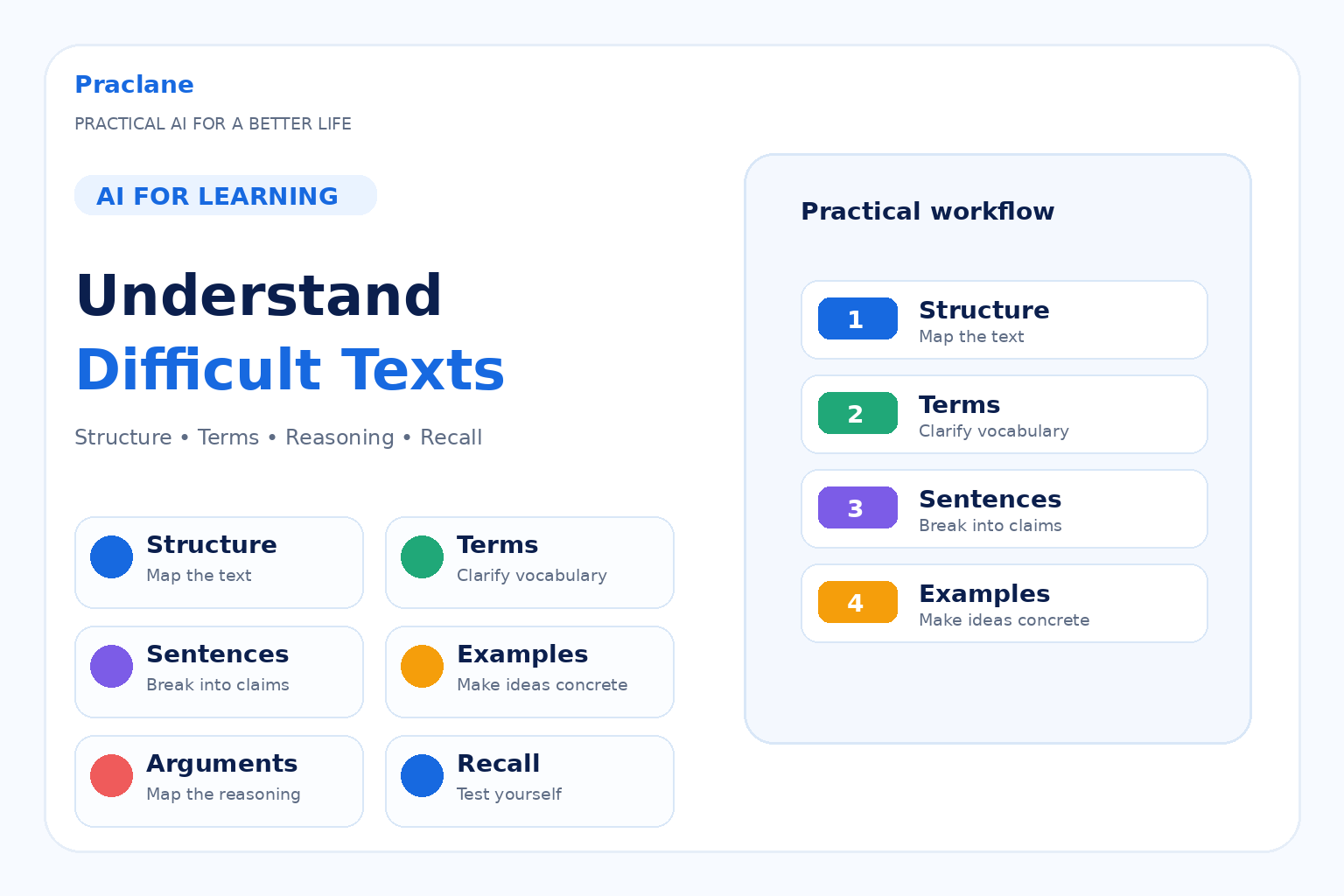
1. Preview the Structure Before Reading Closely
Before explaining this text, map its structure. Identify the main topic, section purposes, key terms, major claims, examples, and the order in which the ideas depend on one another. Do not summarize every detail yet: [text]
A structure map gives you a mental outline before you start working through the difficult parts.
2. Identify the Terms That Block Understanding
Find the 10 terms in this passage that a beginner is most likely to misunderstand. Define each term in plain language, then show what it means in this specific passage. Keep technical meaning intact: [text]
The same word can have a different meaning in economics, law, biology, philosophy, or everyday speech, so context matters.
3. Break Long Sentences Into Smaller Claims
Break this sentence into smaller statements. Show the subject, main claim, conditions, exceptions, and any cause-and-effect relationship. Then rewrite it in simpler language without changing the meaning: [sentence]
This is especially useful for academic writing, policies, technical documentation, and formal arguments.
4. Ask for Two Levels of Explanation
Explain this idea twice. Version 1 should be for a beginner with no background. Version 2 should use the correct technical vocabulary and preserve the important nuance. Then list what the beginner version leaves out: [text]
Simplification is useful only when you can see what was simplified away.
5. Generate a Concrete Example
Give me one concrete example of this concept using a realistic situation. Then map each part of the example back to the original concept so I can see exactly how the example fits: [concept]
Examples are most useful when the relationship to the abstract idea is made explicit.
6. Turn the Passage Into an Argument Map
Map the argument in this passage. Separate the main conclusion, supporting reasons, evidence, assumptions, counterarguments, and limitations. If something is implied rather than stated, label it as an inference: [passage]
This helps when the text is difficult because the reasoning is hidden inside long prose.
7. Ask Questions Instead of Asking for More Explanation
Do not explain this passage yet. Ask me five questions that reveal whether I understand the key idea, the reasoning, the evidence, and the main limitation. Ask one question at a time and wait for my answer: [passage]
Questions expose the difference between recognizing an explanation and being able to reproduce the idea yourself.
8. Compare the Difficult Idea With Something You Already Know
Compare [new concept] with [concept I already know]. Show similarities, differences, where the analogy works, and where it breaks down. Do not force the analogy if the concepts are fundamentally different.
A comparison can provide a bridge, but a bad analogy can also create misunderstanding. Asking where the analogy fails is important.
9. Build a Layered Summary
Summarize this text at three levels: 1 sentence, 5 bullet points, and a detailed explanation. Keep the same core meaning across all three levels. Then tell me which details disappear as the summary gets shorter: [text]
This lets you see both the central idea and the detail that supports it.
10. Finish With Active Recall
Close the explanation and quiz me on this text. Ask one question at a time. Start with the main idea, then move to relationships, examples, assumptions, and limitations. After each answer, tell me what I missed before continuing.
For a more complete testing workflow, see our exam prep guide.
A Reusable Difficult-Text Prompt
Help me understand this text without replacing it. First map the structure and identify difficult terms. Then explain the hardest ideas in plain language while preserving important nuance. Show one concrete example, identify assumptions or hidden reasoning, and ask me questions to check my understanding. Point me back to the original passage whenever the exact wording matters: [text]
What to Do When ChatGPT’s Explanation Conflicts With the Text
Return to the original passage. Ask ChatGPT to show exactly which sentence supports its interpretation. If the explanation depends on outside information, separate that information from what the text itself says.
For important factual claims, use the process in our verification guide.
Common Reading Mistakes
- Asking for a summary before identifying what is difficult.
- Accepting a simple explanation that removes important nuance.
- Using examples without checking how they map to the concept.
- Reading the AI explanation but never returning to the original passage.
- Confusing recognition with real understanding.
- Letting ChatGPT answer every question before you try.
- Ignoring disagreement between the text and the AI’s interpretation.
Frequently Asked Questions
Can ChatGPT explain difficult academic text?
Yes. It can define terminology, break long sentences into smaller claims, create examples, map arguments, and explain material at different levels. Important interpretations should still be checked against the source.
Should I ask ChatGPT to summarize every chapter?
Not necessarily. A summary is helpful for orientation, but understanding improves when you also answer questions, explain ideas from memory, and work through the difficult sections directly.
Can ChatGPT help with technical vocabulary?
Yes. Ask for both a plain-language definition and the meaning of the term in the specific passage. This reduces the risk of learning a generic definition that does not fit the context.
Can I use this method with PDFs?
Yes. You can upload supported PDF files to ChatGPT and apply the same reading prompts to the document. For document-specific limitations and workflows, use our PDF guide.
Final Thoughts
ChatGPT is most useful for difficult reading when it helps you move back and forth between explanation and the original text.
Map the structure, clarify the terms, unpack the reasoning, test yourself, and keep returning to the source until you can explain it without help.