Compare Supplier Quotes with ChatGPT on the Same Pricing Basis
Define what every quote must cover
A lower unit price can hide an incomplete offer. Write one purchase requirement: specification, quantity, required services, destination, currency, and tax basis. Compare each quote against that requirement, with gaps left visible.
This fictional example requests 20 office chairs meeting the same written specification, delivered and assembled. All stated prices are in EUR and exclude VAT. We compare only amounts before VAT; no VAT rate is supplied or calculated. The example illustrates arithmetic and missing information, not a recommendation about real suppliers.
Specification equivalence still needs confirmation against the actual model and details in each quote. A similar product name is insufficient. Keep optional extras outside the required scope unless you explicitly decide to include them.
Keep the evidence beside each comparison row
Label original quotes [A], [B], and [C]. Preserve relevant wording, available page or line references, and document dates. Share only authorized material; remove unnecessary contact details and confidential information.
Ask it to extract quantities, units, inclusions, exclusions, fees, and timing before calculating. Every extracted claim should retain its source ID and a short quoted fragment. If a scanned line is unclear, mark it unreadable and check the original instead of letting the model complete it.
The table retains those fictional source IDs. Its invented fragments illustrate this example; they are not quotations from the official guidance linked below.
On a small screen, swipe the table left or right to see every column.
| Quote and source fragments | Required-scope cost before VAT | Timing and comparison status |
|---|---|---|
| [A] ‘Quantity: 20; unit price: EUR 85’; ‘Delivery: EUR 80 per order’; ‘Assembly included’; ‘Arrival: 7 business days after order confirmation’ | 20 × EUR 85 + EUR 80 = EUR 1,780; assembly included | Arrival in 7 business days after order confirmation. Stated delivery and assembly scope covered; specification still needs confirmation. |
| [B] ‘Quantity: 20; unit price: EUR 79’; ‘Delivery included’; ‘Assembly: EUR 120 per order’; ‘Arrival: 5 business days after order confirmation’ | 20 × EUR 79 + EUR 120 = EUR 1,700; delivery included | Arrival in 5 business days after order confirmation. Stated delivery and assembly scope covered; specification still needs confirmation. |
| [C] ‘Quantity: 20; unit price: EUR 75’; ‘Delivery cost to be confirmed’; ‘Assembly excluded’; ‘Dispatch within 2 business days after order confirmation’ | 20 × EUR 75 = EUR 1,500 known product subtotal. Required matching-scope total unknown: delivery unpriced and assembly excluded with no price. | Dispatch within 2 business days after order confirmation; arrival not stated. Delivery cost and assembly availability/price need clarification. |
Calculate stated costs and preserve unknowns
Use quantity × unit price plus applicable flat fees. Check whether each fee applies per chair or per order: multiplying a per-order assembly fee by 20 would distort the result. ‘Included’ is evidence that a service is covered; silence about a fee is not evidence that it is free.
A totals EUR 1,780 and B totals EUR 1,700 before VAT for the stated delivered-and-assembled scope. B is EUR 80 lower on that known comparison. This is a cost difference, not an overall best-buy judgment: model equivalence, payment terms, and other unresolved conditions can affect a decision.
C has a known product subtotal of EUR 1,500. Its matching-scope total remains unknown. Do not replace unpriced delivery or excluded assembly with zero, assume assembly is available, or rank C as cheapest. Ask whether the required assembly can be supplied, by whom, and at what additional cost.
Run the comparison in two passes
First, have ChatGPT build the evidence rows and list ambiguities without choosing a supplier. Check those rows against the original quotes, especially numbers, fee units, exclusions, and timing. Correct the extracted information before asking for a cost comparison.
Second, request explicit calculations and a short conclusion limited to comparable, stated facts. Keep dispatch and arrival in separate fields: C’s two-business-day dispatch statement does not promise arrival within two business days. Save the checked table with the original quote versions so a revised fee can be traced later.
Use the shared prompt with your requirement and authorized quote excerpts, then review the resulting evidence and arithmetic yourself.
Open the supplier quote comparison prompt
Ask questions that close the actual gaps
Draft focused clarification questions tied to each quote ID. Check the following across all three quotes; C also needs delivery pricing and an answer about assembly.
- Does the quoted model meet every item in the same written specification? Are quantity and unit labels explicit and consistent?
- Which services are required, optional, included, or excluded? Can excluded required services actually be supplied?
- Is the currency and tax basis the same throughout? Is each extra fee per unit or per order?
- What is the expected arrival date or window after order confirmation, separately from dispatch?
- Until when is the quote valid, and what payment terms apply? Are any other required charges unresolved?
Review the result before making a decision
Official supplier guidance treats price alongside reliability and other business needs, while quote guidance emphasizes clear scope, itemised costs, and terms. Those principles support a structured comparison; they do not validate these fictional suppliers or turn a subtotal into a complete offer.
OpenAI advises verifying important information because ChatGPT can produce incorrect or misleading answers. Recheck the source fragments, arithmetic, and supplier clarifications before relying on the table. End with a bounded conclusion: B has the lower stated matching-scope cost than A; C remains incomplete. Do not invent quality scores or turn this comparison into an order or message.
Related guide and official references
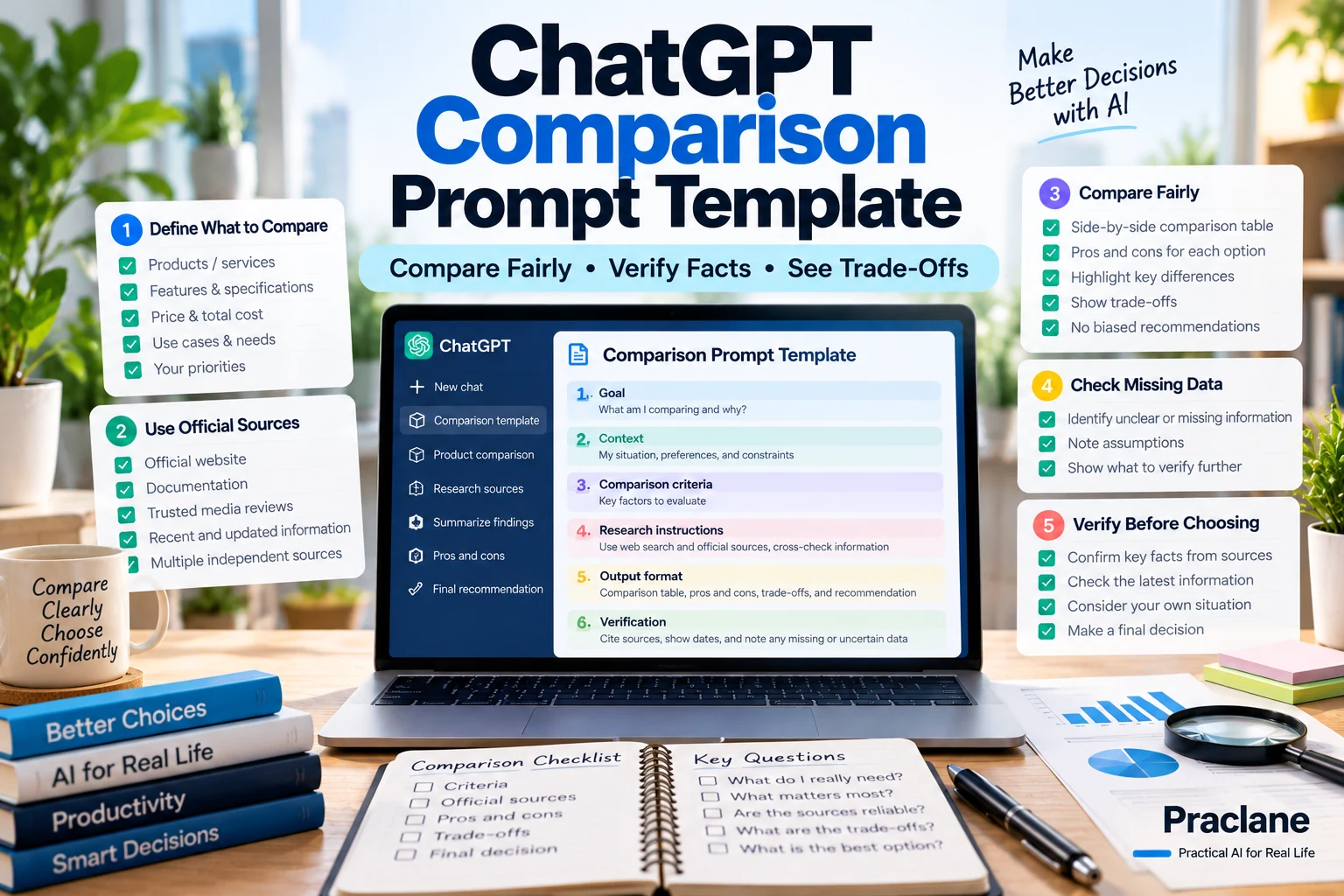
- ChatGPT comparison prompt template
- business.gov.au: Suppliers
- business.gov.au: Prepare quotes
- OpenAI: Does ChatGPT tell the truth?
The linked official sources support general supplier-selection, clear itemisation and terms, and important-information verification principles. The EUR chair quotes, quoted fragments, calculations, and workflow are our own fictional worked example, not a model test. This article does not apply country-specific legal or tax guidance.