How to Use ChatGPT for Resumes and Cover Letters: 12 Practical Workflows for Job Applications
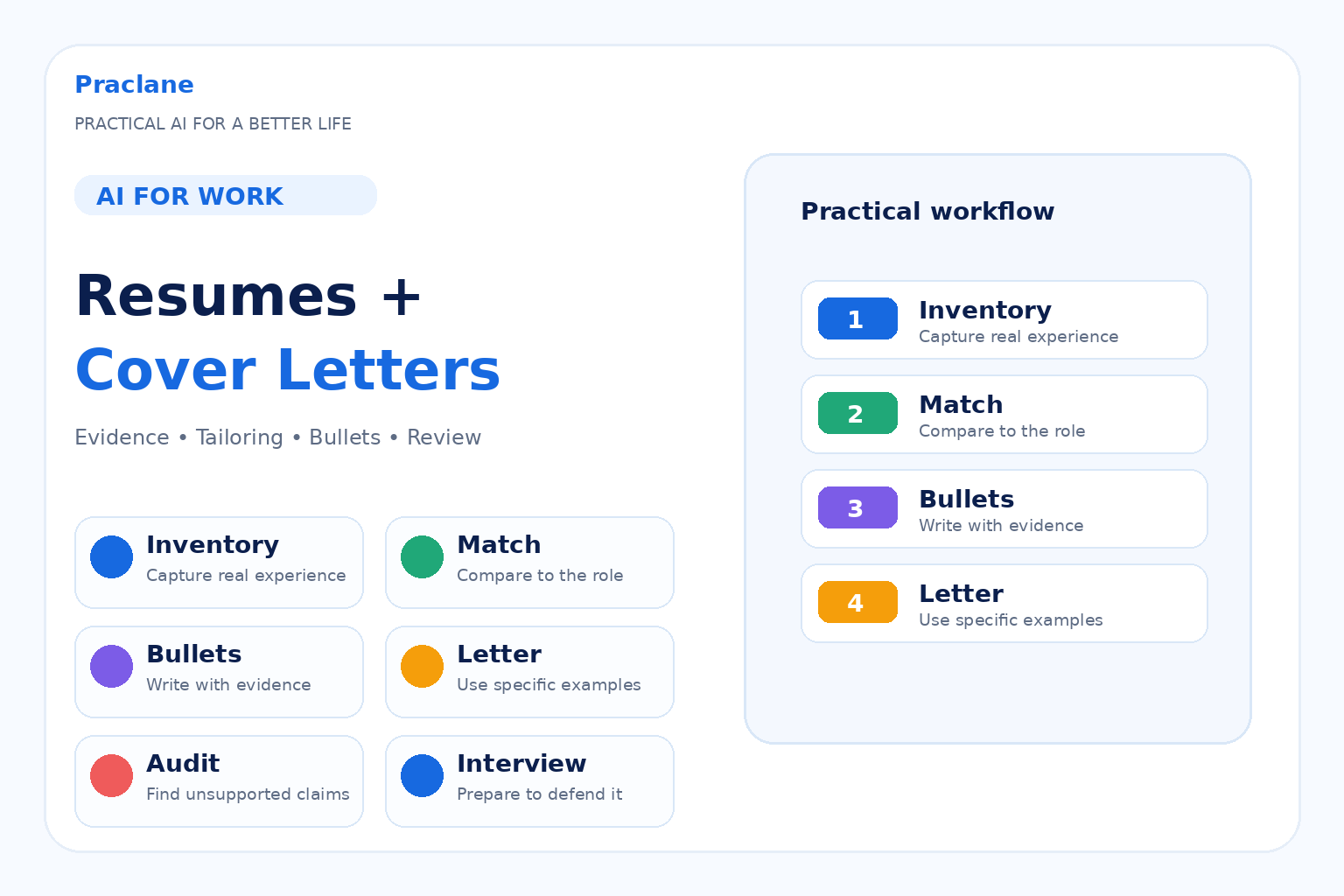
ChatGPT can make job applications faster, but the most useful workflow is not “write my resume for me.” It is using AI to clarify what you actually did, match your real experience to a role, improve wording, and catch weak or unsupported claims before you apply.
This guide shows how to use ChatGPT for resumes and cover letters with 12 practical workflows that keep the final application accurate and personal.
For broader workplace use, see our ChatGPT for work guide. For reusable prompt structure, see our prompt templates.
The Main Rule: Never Invent Experience
A polished application is useful only if it remains true. Do not let ChatGPT create degrees, certifications, job duties, metrics, tools, leadership experience, or achievements you cannot support.
Use AI to improve how real experience is communicated—not to manufacture qualifications.
1. Turn Raw Experience Into a Career Inventory
Help me build a career inventory from these notes. Separate Job Title, Responsibilities, Tools, Skills, Projects, Achievements, Problems Solved, People Worked With, and Evidence or Metrics. Do not improve or invent anything yet: [notes]
This creates a fact base you can reuse across multiple applications.
2. Analyze the Job Description Before Editing the Resume
Analyze this job description. Separate required qualifications, preferred qualifications, responsibilities, tools, repeated keywords, and likely priorities. Do not tell me whether I am qualified yet: [job description]
The goal is to understand what the employer is asking for before changing your application.
3. Map Your Real Experience to the Role
Compare my career inventory with this job description. Create three sections: Strong Matches, Partial Matches, and Gaps. Only use experience I actually provided. For every match, point to the supporting experience.
This is more useful than asking ChatGPT to declare you a “good fit” because it makes the evidence visible.
4. Rewrite Resume Bullets Around Action and Evidence
Rewrite these resume bullets to be concise and specific. Start with a strong action, explain what I did, and include a result only when I actually provided one. Do not invent numbers. Give me three versions for each bullet: straightforward, impact-focused, and technical: [bullets]
When you do not have a numerical result, a clear description of scope, responsibility, quality, speed, reliability, or complexity can still be useful.
5. Identify Where Metrics Would Help
Review these bullets and identify where a real metric could make the claim stronger. Ask me questions that could uncover quantity, time saved, error reduction, project size, frequency, team size, customer volume, or other evidence. Do not supply the numbers yourself.
This helps you remember evidence without fabricating it.
6. Tailor the Summary Without Keyword Stuffing
Write a 3-line professional summary using only my verified experience. Reflect the most important requirements in this job description, but do not copy phrases unnaturally or claim skills I do not have: [experience] [job description]
The summary should quickly explain the relevant background, not repeat the entire resume.
7. Reorder Skills for Relevance
Reorder this skills list for the target role. Keep only skills I actually have. Group them into useful categories and flag any item that is too vague to be meaningful: [skills] [job description]
8. Draft a Cover Letter From Evidence
Draft a concise cover letter for this role using only the experience I provide. Paragraph 1: why this role. Paragraph 2: two specific examples that match the employer’s needs. Paragraph 3: short close. Avoid clichés, exaggerated enthusiasm, and unsupported claims: [experience] [job description] [reason for interest]
A cover letter becomes more convincing when it contains a small number of specific examples instead of a long list of generic strengths.
9. Make the Cover Letter Sound Like You
Here are three short samples of how I naturally write: [samples]. Rewrite this cover letter to match that level of formality and sentence style. Keep all facts unchanged and remove generic AI-sounding phrases.
For other professional writing workflows, see our ChatGPT email guide.
10. Check for Unsupported Claims
Audit this resume and cover letter. Mark every claim as Supported by My Notes, Needs Verification, or Unsupported. Pay special attention to numbers, titles, years of experience, certifications, software proficiency, leadership, and outcomes: [application] [my notes]
This is one of the most valuable final checks: a stronger sentence is not worth using if the evidence behind it is weak.
11. Proofread for Clarity and Consistency
Proofread this application without changing the facts. Check grammar, tense consistency, duplicated wording, vague verbs, inconsistent dates, inconsistent job titles, punctuation, and formatting language. List proposed changes before rewriting anything.
12. Turn the Application Into Interview Preparation
Using this resume and job description, create 12 interview questions I should be ready to answer. Prioritize claims in my resume that an interviewer may ask me to prove with examples. Ask one question at a time and challenge vague answers.
This helps make sure the story told by the resume is one you can confidently explain in person.
A Reusable Resume-Tailoring Prompt
Help me tailor my resume for this job. My verified experience is [experience]. The job description is [job description]. First identify the strongest matches, partial matches, and gaps. Then suggest changes to ordering, summary, skills, and bullet wording. Do not invent qualifications, metrics, tools, responsibilities, or achievements. Flag anything that needs verification before I use it.
Common Resume and Cover Letter Mistakes
- Asking AI to write the application before giving it real experience.
- Adding invented percentages or performance numbers.
- Copying every keyword from the job description.
- Using vague phrases such as “results-driven professional” without evidence.
- Submitting the same cover letter to every employer.
- Letting AI change dates, job titles, or scope.
- Using wording you would not be comfortable explaining in an interview.
Frequently Asked Questions
Can ChatGPT write my resume?
It can help structure and rewrite your resume, but you should provide the underlying facts and verify every claim before submitting it.
Can ChatGPT tailor a resume to a job description?
Yes. A useful method is to compare the job requirements with a factual inventory of your experience, then adjust emphasis and wording without adding qualifications you do not have.
Should I use AI-generated metrics?
No. Use only numbers you can support. ChatGPT can help you identify where a metric would be useful and ask questions that help you recover the real value.
Can employers detect an AI-written cover letter?
Detection claims are unreliable. A better concern is quality: generic, exaggerated, or impersonal writing can make an application weaker regardless of how it was produced. Edit the final letter so it accurately reflects your experience and voice.
Final Thoughts
ChatGPT is most useful for job applications when it helps you make your real experience easier to understand.
Build from evidence, tailor for relevance, remove unsupported claims, and make sure every sentence is something you can defend in an interview.